
|
You entered: Earth
 APOD: 2025 April 22 Б Terminator Moon: A Moonscape of Shadows
22.04.2025
What's different about this Moon? It's the terminators. In the featured image, you can't directly see any terminator -- the line that divides the light of day from the dark of night. That's because the featured image is a digital composite of many near-terminator lunar strips over a full Moon.
 Breaking Distant Light
4.01.2009
In the distant universe, time appears to run slow. Since time-dilated light appears shifted toward the red end of the spectrum (redshifted), astronomers are able to use cosmological time-slowing to help measure vast distances in the universe.
 Shadow of a Martian Robot
28.03.2015
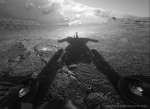
What if you saw your shadow on Mars and it wasn't human? Then you might be the Opportunity rover currently exploring Mars. Opportunity has been exploring the red planet since early 2004, finding evidence of ancient water, and sending breathtaking images across the inner Solar System.
 JWST: Ghosts and Mirrors
18.03.2017
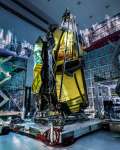
Ghosts aren't actually hovering over the James Webb Space Telescope. But the lights are out as it stands with gold tinted mirror segments and support structures folded in Goddard Space Flight Center's Spacecraft Systems Development and Integration Facility clean room.
 APOD: 2023 December 4 Б Plane Crossing Crescent Moon
4.12.2023
No, the Moon is not a bow, and no, it did not shoot out a plane like an arrow. What is pictured is a chance superposition. The plane's contrail would normally appear white...
 In Green Company: Aurora over Norway
10.12.2017
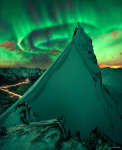
Raise your arms if you see an aurora. With those instructions, two nights went by with, well, clouds -- mostly. On the third night of returning to same peaks, though, the sky not only cleared up but lit up with a spectacular auroral display.
 Comet Hale-Bopp Update
30.10.1995
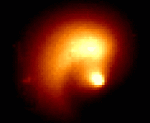
Will comet Hale-Bopp become the brightest comet of the Century in early 1997? Since its discovery in July this year, Hale-Bopp has caused much speculation. Even though it is still beyond the orbit of Jupiter it is astonishingly bright and expected to get much brighter as it plunges inward, toward the Sun.
 Mare Orientale
12.01.1996
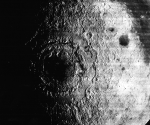
Looking like a target ring bull's-eye, the Mare Orientale is one of the most striking large scale lunar features. Located on the Moon's extreme western edge, this impact basin is unfortunately difficult to see from an earthbound perspective.
 The Keyhole Nebula
12.01.1998
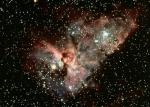
The dark dusty Keyhole Nebula gets its name from its unusual shape. Officially designated NGC 3324, the Keyhole Nebula is a smaller region superposed on the larger Eta Carina Nebula. These nebulae were created by the dying star Eta Carina, which is prone to violent outbursts during its final centuries.
 Morning, Moon, and Mercury
26.04.2012
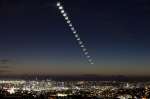
Last week Mercury wandered far to the west of the Sun. As the solar system's innermost planet neared its greatest elongation or greatest angle from the Sun (for this apparition about 27 degrees) it was joined by an old crescent Moon.
|
January February March April May June July August September October |
|||||||||||||||||||||||||||||||||||||||||||||||||