
|
You entered: shock
 Runaway Star Alpha Camelopardalis
28.04.2023
Like a ship plowing through cosmic seas, runaway star Alpha Camelopardalis has produced this graceful arcing bow wave or bow shock. The massive supergiant star moves at over 60 kilometers per second through space, compressing the interstellar material in its path.
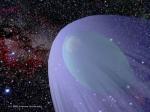 The Suns Heliosphere and Heliopause
24.06.2002
Where does the Sun's influence end? Nobody is sure. Out past the orbits of Neptune and Pluto extends a region named the heliosphere where the Sun's magnetic field and particles from the Solar Wind continue to dominate.
 Filaments In The Cygnus Loop
26.04.2000
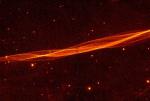
Subtle and delicate in appearance, these are filaments of shocked interstellar gas -- part of the expanding blast wave from a violent stellar explosion. Recorded in November 1997 with the Wide Field and Planetary Camera 2 onboard the Hubble Space Telescope, the picture is a closeup of a supernova remnant known as the Cygnus Loop.
 Webb's Rho Ophiuchi
25.10.2025
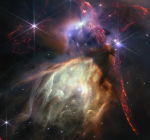
A mere 390 light-years away, Sun-like stars and future planetary systems are forming in the Rho Ophiuchi molecular cloud complex, the closest star-forming region to our fair planet. The James Webb Space Telescope's NIRCam peered into the nearby natal chaos to capture this infrared image at an inspiring scale.
 The Arms of NGC 4258
11.04.2007
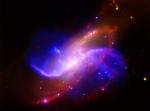
Better known as M106, bright spiral galaxy NGC 4258 is about 30 thousand light years across and 21 million light years away toward the northern constellation Canes Venatici. The yellow and red hues in this composite image show the galaxy's sweeping spiral arms as seen in visible and infrared light.
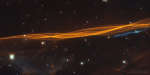 Filaments of the Cygnus Loop
28.09.2020
What lies at the edge of an expanding supernova? Subtle and delicate in appearance, these ribbons of shocked interstellar gas are part of a blast wave at the expanding edge of a violent stellar explosion that would have been easily visible to humans during the late stone age, about 20,000 years ago.
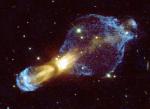 The Making of the Rotten Egg Nebula
3.09.2001
Fast expanding gas clouds mark the end for a central star in the Rotten Egg Nebula. The once-normal star has run out of nuclear fuel, causing the central regions to contract into a white dwarf. Some of the liberated energy causes the outer envelope of the star to expand.
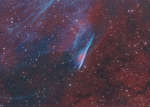 NGC 2736: The Pencil Nebula
21.03.2013
Moving left to right near the center of this beautifully detailed color composite, the thin, bright, braided filaments are actually long ripples in a sheet of glowing gas seen almost edge on. The interstellar shock wave plows through space at over 500,000 kilometers per hour.
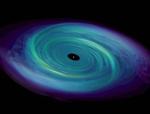 Accretion Disk Simulation
27.09.2002
Don't be fooled by the familiar symmetry. The graceful spiral structure seen in this computer visualization does not portray winding spiral arms in a distant galaxy of stars. Instead, the graphic shows spiral...
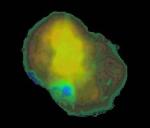 X-Rays From IC 443
2.05.1997
The life-cycles of stars help drive the ecology of our Galaxy, churning, processing, and redistributing matter. Massive stars reach a spectacular evolutionary endpoint - supernovae explosions which blast off their outer layers, violently merging stellar material with the gas and dust of the Milky Way. The supernova remnant IC 443 is typical of the aftermath.
|
January February March April May June July August September |
|||||||||||||||||||||||||||||||||||||||||||||||||