
|
You entered: shock
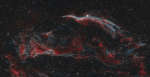 Along the Western Veil
6.09.2018
Delicate in appearance, these filaments of shocked, glowing gas, are draped across planet Earth's sky toward the constellation of Cygnus. They form the western part of the Veil Nebula. The Veil Nebula itself is a large supernova remnant, an expanding cloud born of the death explosion of a massive star.
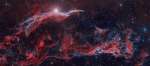 Along the Western Veil
4.04.2014
Delicate in appearance, these filaments of shocked, glowing gas, draped in planet Earth's sky toward the constellation of Cygnus, make up the western part of the Veil Nebula. The Veil Nebula itself is a large supernova remnant, an expanding cloud born of the death explosion of a massive star.
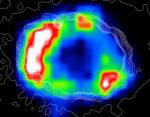 X-Ray Ring Around SN1987A
12.05.2000
This false-color image from the Chandra X-ray Observatory reveals a one light-year diameter ring of hot, ten million degree plasma. It is one of the most detailed X-ray images of the expanding blast wave from supernova 1987A (SN1987A).
 Zeta Oph: Runaway Star
4.01.2024
Like a ship plowing through cosmic seas, runaway star Zeta Ophiuchi produces the arcing interstellar bow wave or bow shock seen in this stunning infrared portrait. In the false-color view, bluish Zeta...
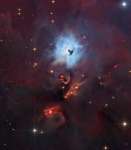 NGC 1999: South of Orion
28.11.2013
South of the large star-forming region known as the Orion Nebula, lies bright blue reflection nebula NGC 1999. At the edge of the Orion molecular cloud complex some 1,500 light-years distant, NGC 1999's illumination is provided by the embedded variable star V380 Orionis.
 APOD: 2026 July 24 Б RCW 86: Historical Supernova Remnant
24.07.2026
In 185 AD, Chinese astronomers recorded the appearance of a new star in the Nanmen asterism. That part of the sky is identified with part of the southern constellation Centaurus on modern star charts.
 Zeta Oph: Runaway Star
2.02.2020
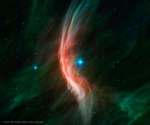
Like a ship plowing through cosmic seas, runaway star Zeta Ophiuchi produces the arcing interstellar bow wave or bow shock seen in this stunning infrared portrait. In the false-color view, bluish Zeta...
 RCW 86: Historical Supernova Remnant
10.11.2011
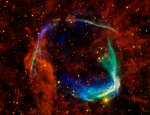
In 185 AD, Chinese astronomers recorded the appearance of a new star in the Nanmen asterism - a part of the sky identified with Alpha and Beta Centauri on modern star charts. The new star was visible for months and is thought to be the earliest recorded supernova.
 Aurora in the Night
31.10.2002
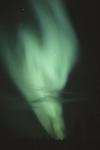
For much of the month of October, traveling shock waves from the Sun and solar wind gusts have buffeted planet Earth's magnetosphere. As a result, skywatchers at high latitudes in the northern hemisphere were treated to many displays of the aurora borealis or northern lights.
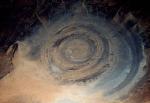 Earth's Richat Structure
5.01.1998
What on Earth is that? The Richat Structure in the Sahara Desert of Mauritania is easily visible from space because it is nearly 50 kilometers across. Once thought to be an impact crater, the Richat Structure's flat middle and lack of shock-altered rock indicates otherwise.
|
January February March April May June July August September |
|||||||||||||||||||||||||||||||||||||||||||||||||