
|
You entered: shock
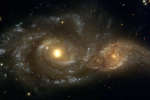 Spiral Galaxies in Collision
20.04.2008
Billions of years from now, only one of these two galaxies will remain. Until then, spiral galaxies NGC 2207 and IC 2163 will slowly pull each other apart, creating tides of matter, sheets of shocked gas, lanes of dark dust, bursts of star formation, and streams of cast-away stars.
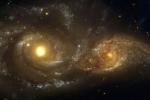 Spiral Galaxies in Collision
9.11.1999
Billions of years from now, only one of these two galaxies will remain. Until then, spiral galaxies NGC 2207 and IC 2163 will slowly pull each other apart, creating tides of matter, sheets of shocked gas, lanes of dark dust, bursts of star formation, and streams of cast-away stars.
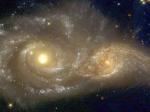 Spiral Galaxies in Collision
21.11.2004
Billions of years from now, only one of these two galaxies will remain. Until then, spiral galaxies NGC 2207 and IC 2163 will slowly pull each other apart, creating tides of matter, sheets of shocked gas, lanes of dark dust, bursts of star formation, and streams of cast-away stars.
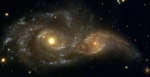 Spiral Galaxies in Collision
19.01.2014
Billions of years from now, only one of these two galaxies will remain. Until then, spiral galaxies NGC 2207 and IC 2163 will slowly pull each other apart, creating tides of matter, sheets of shocked gas, lanes of dark dust, bursts of star formation, and streams of cast-away stars.
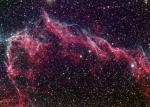 NGC 6992: A Glimpse of the Veil
28.09.2001
After 5,000 years, the gorgeous Veil Nebula is still turning heads. Cataloged as NGC 6992, these glowing filaments of interstellar shocked gas are part of a larger spherical supernova remnant known as the Cygnus Loop or the Veil Nebula -- expanding debris from a star which exploded over 5,000 years ago.
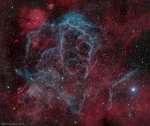 Vela Supernova Remnant
10.09.2010
The plane of our Milky Way Galaxy runs through this complex and beautiful skyscape. At the northwestern edge of the constellation Vela (the Sails) the four frame mosaic is over 10 degrees wide, centered on the glowing filaments of the Vela Supernova Remnant, the expanding debris cloud from the death explosion of a massive star.
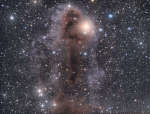 Lynds Dark Nebula 1251
31.05.2019
Stars are forming in Lynds Dark Nebula (LDN) 1251. About 1,000 light-years away and drifting above the plane of our Milky Way galaxy, the dusty molecular cloud is part of a complex of dark nebulae mapped toward the Cepheus flare region.
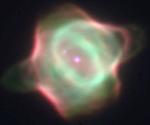 Hen 1357: New Born Nebula
3.04.1998
This Hubble Space Telescope picture shows Hen-1357, the youngest known planetary nebula. Graceful, gentle curves and symmetry suggest its popular name - The Stingray Nebula. Observations in the 1970s detected no nebular material, but this image from March 1996 clearly shows the Stingray's emerging bubbles and rings of shocked and ionized gas.
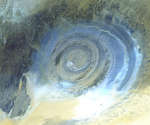 Earths Richat Structure
19.05.2013
What on Earth is that? The Richat Structure in the Sahara Desert of Mauritania is easily visible from space because it is nearly 50 kilometers across. Once thought to be an impact crater, the Richat Structure's flat middle and lack of shock-altered rock indicates otherwise.
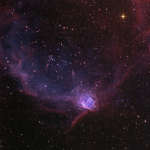 NGC 602 in the Flying Lizard Nebula
6.03.2015
Near the outskirts of the Small Magellanic Cloud, a satellite galaxy some 200 thousand light-years distant, lies 5 million year young star cluster NGC 602. Surrounded by natal gas and dust, NGC 602 is just below center in this telescopic field of view with the angular size of the Full Moon on the sky.
|
January February March April May June July August September |
|||||||||||||||||||||||||||||||||||||||||||||||||