
|
You entered: shock
 APOD: 2025 August 4 Б Blue Arcs Toward Andromeda
3.08.2025
What are these gigantic blue arcs near the Andromeda Galaxy (M31)? Discovered in 2022 by amateur astronomers, the faint arcs -- dubbed SDSO 1 -- span nearly the same angular size as M31 itself. At first, their origin was a mystery: are they actually near the Andromeda Galaxy, or alternatively near to our Sun?
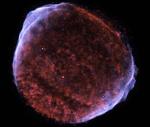 SN 1006: Supernova Remnant in X Rays
25.12.2005
This huge puff ball was once a star. One thousand years ago, in the year 1006, a new star was recorded in the sky that today we know was really an existing star exploding.
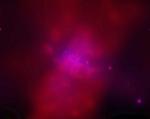 M82: Starburst in X-rays
21.04.2000
Star formation occurs at a faster pace in M82 -- a galaxy with about 10 times the rate of massive star birth (and death) compared to our Milky Way. Winds from massive stars and blasts...
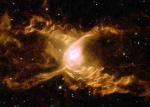 The Red Spider Planetary Nebula
24.07.2001
Oh what a tangled web a planetary nebula can weave. The Red Spider Planetary Nebula shows the complex structure that can result when a normal star ejects its outer gases and becomes a white dwarf star.
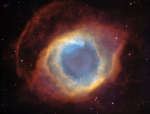 The Helix Nebula from Blanco and Hubble
12.10.2014
How did a star create the Helix nebula? The shapes of planetary nebula like the Helix are important because they likely hold clues to how stars like the Sun end their lives. Observations...
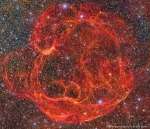 Simeis 147: Supernova Remnant
24.04.2016
It's easy to get lost following the intricate strands of the Spaghetti Nebula. A supernova remnant cataloged as Simeis 147 and Sh2-240, the glowing gas filaments cover nearly 3 degrees -- 6 full moons -- on the sky. That's about 150 light-years at the stellar debris cloud's estimated distance of 3,000 light-years.
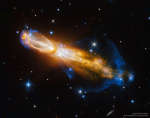 The Calabash Nebula from Hubble
14.02.2017
Fast expanding gas clouds mark the end for a central star in the Calabash Nebula. The once-normal star has run out of nuclear fuel, causing the central regions to contract into a white dwarf. Some of the liberated energy causes the outer envelope of the star to expand.
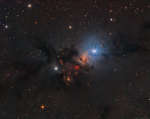 NGC 1333: Stellar Nursery in Perseus
26.03.2019
NGC 1333 is seen in visible light as a reflection nebula, dominated by bluish hues characteristic of starlight reflected by interstellar dust. A mere 1,000 light-years distant toward the heroic constellation Perseus, it lies at the edge of a large, star-forming molecular cloud.
 Stardust in the Perseus Molecular Cloud
24.01.2025
Clouds of stardust drift through this deep skyscape, across the Perseus molecular cloud some 850 light-years away. Dusty nebulae reflecting light from embedded young stars stand out in the nearly 4 degree wide field of view. With a characteristic bluish color reflection nebula NGC 1333 is prominent near center.
 APOD: 2025 April 9 Б HH 49: Interstellar Jet from Webb
8.04.2025
What's at the tip of this interstellar jet? First let's consider the jet: it is being expelled by a star system just forming and is cataloged as Herbig-Haro 49 (HH 49). The star system expelling this jet is not visible -- it is off to the lower right.
|
January February March April May June July August |
||||||||||||||||||||||||||||||||||||||||||||||||||||||||