
|
You entered: shock
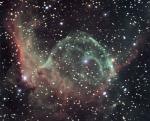 NGC 2359: Thor s Helmet
5.12.2002
NGC 2359 is a striking emission nebula with an impressive popular name - Thor's Helmet. Sure, its suggestive winged appearance might lead some to refer to it as the "duck nebula", but if you were a nebula which name would you choose?
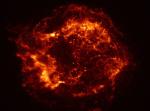 Chandras First Light: Cassiopeia A
27.08.1999
Cosmic wreckage from the detonation of a massive star is the subject of this official first image from NASA's Chandra X-ray Observatory. The supernova remnant, known as Cassiopeia A, was produced when a star exploded around 300 years ago in this northern sky constellation.
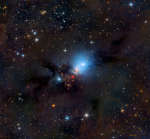 NGC 1333 Stardust
6.03.2014
NGC 1333 is seen in visible light as a reflection nebula, dominated by bluish hues characteristic of starlight reflected by dust. A mere 1,000 light-years distant toward the heroic constellation Perseus, it lies at the edge of a large, star-forming molecular cloud.
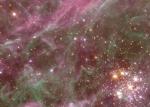 Denizen of the Tarantula Nebula
7.04.1999
The star cluster at lower right, cataloged as Hodge 301, is a denizen of the Tarantula Nebula. An evocative nebula in the southern sky, the sprawling cosmic Tarantula is an energetic star forming region some 168,000 light-years distant in our neighboring galaxy the Large Magellanic Cloud.
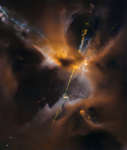 Herbig Haro 24
18.12.2015
This might look like a double-bladed lightsaber, but these two cosmic jets actually beam outward from a newborn star in a galaxy near you. Constructed from Hubble Space Telescope image data, the stunning scene...
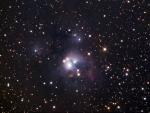 Young Suns of NGC 7129
11.08.2005
Young suns still lie within dusty NGC 7129, some 3,000 light-years away toward the royal constellation Cepheus. While these stars are at a relatively tender age, only about a million years old, it is likely that our own Sun formed in a similar stellar nursery some five billion years ago.
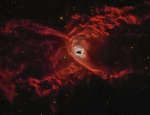 The Red Spider Planetary Nebula
29.10.2012
Oh what a tangled web a planetary nebula can weave. The Red Spider Planetary Nebula shows the complex structure that can result when a normal star ejects its outer gases and becomes a white dwarf star.
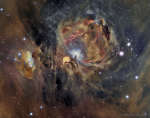 Orion Nebula in Oxygen, Hydrogen, and Sulfur
4.10.2020
Few astronomical sights excite the imagination like the nearby stellar nursery known as the Orion Nebula. The Nebula's glowing gas surrounds hot young stars at the edge of an immense interstellar molecular cloud.
 APOD: 2025 January 6 Б Colliding Spiral Galaxies from Webb and Hubble
6.01.2025
Billions of years from now, only one of these two galaxies will remain. Until then, spiral galaxies NGC 2207 and IC 2163 will slowly pull each other apart, creating tides of matter, sheets of shocked gas, lanes of dark dust, bursts of star formation, and streams of cast-away stars.
 Supernova Remnant: Cooking Elements In The LMC
9.05.1996
Massive stars cook elements in their cores through nuclear fusion. Starting with the light elements of hydrogen and helium, their central temperatures and pressures produce progressively heavier elements, carbon, oxygen, nitrogen, etc. up through iron.
|
January February March April May June July August September |
|||||||||||||||||||||||||||||||||||||||||||||||||