
|
You entered: shock
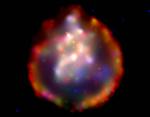 72.6: Oxygen Supply
28.05.2003
A supernova explosion, a massive star's inevitable and spectacular demise, blasts back into space debris enriched in the heavy elements forged in its stellar core. Incorporated into future stars and planets, these are the elements ultimately necessary for life.
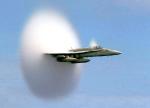 A Sonic Boom
20.02.2001
Many people have heard a sonic boom, but few have seen one. When an airplane travels at a speed faster than sound, density waves of sound emitted by the plane cannot precede the plane, and so accumulate in a cone behind the plane.
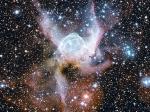 Thors Helmet from CFHT
29.01.2007
NGC 2359 is a striking emission nebula with an impressive popular name - Thor's Helmet Sure, its suggestive winged appearance might lead some to refer to it as the "duck nebula", but if you were a nebula which name would you choose?
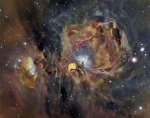 Orion Nebula in Oxygen, Hydrogen, and Sulfur
4.06.2013
Few astronomical sights excite the imagination like the nearby stellar nursery known as the Orion Nebula. The Nebula's glowing gas surrounds hot young stars at the edge of an immense interstellar molecular cloud.
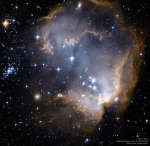 NGC 602 and Beyond
15.05.2021
The clouds may look like an oyster, and the stars like pearls, but look beyond. Near the outskirts of the Small Magellanic Cloud, a satellite galaxy some 200 thousand light-years distant, lies 5 million year young star cluster NGC 602.
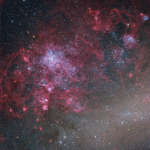 The Tarantula Zone
12.06.2014
The Tarantula Nebula is more than 1,000 light-years in diameter, a giant star forming region within our neighboring galaxy the Large Magellanic Cloud (LMC). That cosmic arachnid lies toward the upper left in this deep and colorful telescopic view made through broad-band and narrow-band filters.
 Neptune's Great Dark Spot: Gone But Not Forgotten
30.11.2001
When NASA's Voyager 2 spacecraft flew by distant Neptune in August of 1989, astronomers were shocked. Since Neptune receives only 3 percent the sunlight Jupiter does, they expected to find a dormant, dark, frigid planet. Instead, the Voyager images revealed evidence of a dynamic and turbulent world.
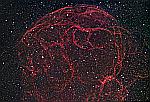 Simeis 147: Supernova Remnant
23.03.2005
It's easy to get lost following the intricate filaments in this detailed image of faint supernova remnant Simeis 147. Seen towards the constellation Taurus it covers nearly 3 degrees (6 full moons) on the sky corresponding to a width of 150 light-years at the stellar debris cloud's estimated distance of 3,000 light-years.
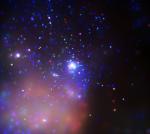 X Ray Portrait of Trumpler 14
2.09.2005
A wonder of planet Earth's southern sky, star cluster Trumpler 14 lies about nine thousand light-years away in the Carina complex -- a rich star forming region at the edge of a giant molecular cloud.
 APOD: 2023 September 19 Б HH 211: Jets from a Forming Star
18.09.2023
Do stars always create jets as they form? No one is sure. As a gas cloud gravitationally contracts, it forms a disk that can spin too fast to continue contracting into a protostar. Theorists hypothesize that this spin can be reduced by expelling jets.
|
January February March April May June July August |
||||||||||||||||||||||||||||||||||||||||||||||||||||||||