
|
You entered: shock
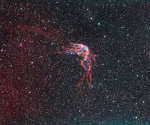 RCW 86: Historical Supernova Remnant
28.05.2022
In 185 AD, Chinese astronomers recorded the appearance of a new star in the Nanmen asterism. That part of the sky is identified with Alpha and Beta Centauri on modern star charts. The new star was visible for months and is thought to be the earliest recorded supernova.
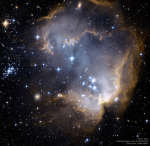 APOD: 2026 April 13 Б NGC 602 and Beyond
13.04.2026
The clouds may look like an oyster, and the stars like pearls, but look beyond. Near the outskirts of the Small Magellanic Cloud, a satellite galaxy some 200 thousand light-years distant, lies 5 million year young star cluster NGC 602.
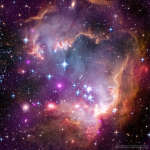 NGC 602 and Beyond
2.04.2017
Near the outskirts of the Small Magellanic Cloud, a satellite galaxy some 200 thousand light-years distant, lies 5 million year young star cluster NGC 602. Surrounded by natal gas and dust...
 APOD: 2024 August 28 Б Tulip Nebula and Black Hole Cygnus X 1
28.08.2024
When can you see a black hole, a tulip, and a swan all at once? At night -- if the timing is right, and if your telescope is pointed in the right direction. The complex and beautiful Tulip Nebula blossoms about 8,000 light-years away toward the constellation of Cygnus the Swan.
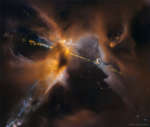 Duel Particle Beams in Herbig Haro 24
11.03.2018
This might look like a double-bladed lightsaber, but these two cosmic jets actually beam outward from a newborn star in a galaxy near you. Constructed from Hubble Space Telescope image data, the stunning scene...
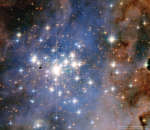 Young Star Cluster Trumpler 14 from Hubble
14.05.2019
Why does star cluster Trumpler 14 have so many bright stars? Because it is so young. Many cluster stars have formed only in the past 5 million years and are so hot they emit detectable X-rays.
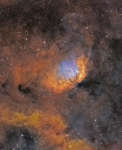 The Tulip in the Swan
14.11.2014
Framing a bright emission region this telescopic view looks out along the plane of our Milky Way Galaxy toward the nebula rich constellation Cygnus the Swan. Popularly called the Tulip Nebula the glowing cloud of interstellar gas and dust is also found in the 1959 catalog by astronomer Stewart Sharpless as Sh2-101.
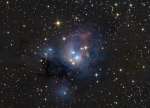 Young Suns of NGC 7129
27.10.2011
Young suns still lie within dusty NGC 7129, some 3,000 light-years away toward the royal constellation Cepheus. While these stars are at a relatively tender age, only a few million years old, it is likely that our own Sun formed in a similar stellar nursery some five billion years ago.
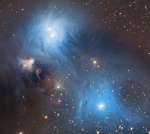 Stars and Dust in Corona Australis
18.10.2017
Blue dust clouds and young, energetic stars inhabit this telescopic vista, less than 500 light-years away toward the northern boundary of Corona Australis, the Southern Crown. The dust clouds effectively block light from more distant background stars in the Milky Way.
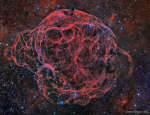 Simeis 147: Supernova Remnant
18.05.2017
It's easy to get lost following intricate filaments in this detailed image of faint supernova remnant Simeis 147. Also cataloged as Sharpless 2-240 it goes by the popular nickname, the Spaghetti Nebula. Seen toward the boundary of the constellations Taurus and Auriga, it covers nearly 3 degrees or 6 full moons on the sky.
|
January February March April May June July August September |
|||||||||||||||||||||||||||||||||||||||||||||||||