
|
You entered: shock
 The Tarantula Nebula from SuperBIT
27.04.2023
The Tarantula Nebula, also known as 30 Doradus, is more than a thousand light-years in diameter, a giant star forming region within nearby satellite galaxy the Large Magellanic Cloud. About 160 thousand light-years away, it's the largest, most violent star forming region known in the whole Local Group of galaxies.
 The Swirling Core of the Crab Nebula
8.07.2016
At the core of the Crab Nebula lies a city-sized, magnetized neutron star spinning 30 times a second. Known as the Crab Pulsar, it's actually the rightmost of two bright stars, just below a central swirl in this stunning Hubble snapshot of the nebula's core.
 Simeis 147: Supernova Remnant
21.11.2019
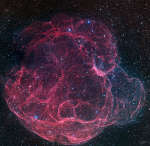
It's easy to get lost following the intricate looping filaments in this detailed image of supernova remnant Simeis 147. Also cataloged as Sharpless 2-240 it goes by the popular nickname, the Spaghetti Nebula.
 Simeis 147: Supernova Remnant
10.12.2020
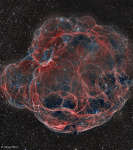
It's easy to get lost following the intricate looping filaments in this detailed image of supernova remnant Simeis 147. Also cataloged as Sharpless 2-240 it goes by the popular nickname, the Spaghetti Nebula.
 Supernova Remnant Simeis 147
13.01.2022
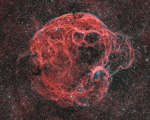
It's easy to get lost following the intricate, looping, twisting filaments in this detailed image of supernova remnant Simeis 147. Also cataloged as Sharpless 2-240 it goes by the popular nickname, the Spaghetti Nebula.
 The Orion Bullets
10.01.2013
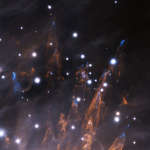
Cosmic bullets pierce the outskirts of the Orion Nebula some 1500 light-years distant in this sharp infrared close-up. Blasted out by energetic massive star formation the bullets, relatively dense, hot gas clouds about ten times the size of Pluto's orbit, are blue in the false color image.
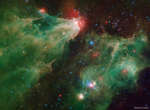 The Cave Nebula in Infrared from Spitzer
11.06.2019
What's happening in and around the Cave Nebula? To help find out, NASA's orbiting Spitzer Space Telescope looked into this optically-dark star-forming region in four colors of infrared light. The Cave Nebula...
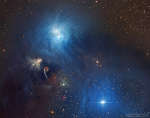 Stars and Dust in Corona Australis
12.01.2020
Cosmic dust clouds and young, energetic stars inhabit this telescopic vista, less than 500 light-years away toward the northern boundary of Corona Australis, the Southern Crown. The dust clouds effectively block light from more distant background stars in the Milky Way.
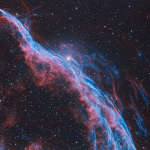 NGC 6960: The Witch s Broom Nebula
29.05.2013
Ten thousand years ago, before the dawn of recorded human history, a new light would have suddenly have appeared in the night sky and faded after a few weeks. Today we know this light was from a supernova, or exploding star, and record the expanding debris cloud as the Veil Nebula, a supernova remnant.
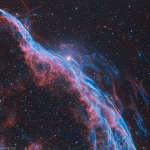 NGC 6960: The Witchs Broom Nebula
8.04.2018
Ten thousand years ago, before the dawn of recorded human history, a new light would have suddenly have appeared in the night sky and faded after a few weeks. Today we know this light was from a supernova, or exploding star, and record the expanding debris cloud as the Veil Nebula, a supernova remnant.
|
January February March April May June July August |
||||||||||||||||||||||||||||||||||||||||||||||||||||||||