
|
You entered: shock
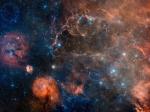 Vela Supernova Remnant in Visible Light
13.02.2007
The explosion is over but the consequences continue. About eleven thousand years ago a star in the constellation of Vela could be seen to explode, creating a strange point of light briefly visible to humans living near the beginning of recorded history.
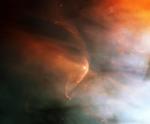 LL Orionis: When Cosmic Winds Collide
15.11.2003
This arcing, graceful structure is actually a bow shock about half a light-year across, created as the wind from young star LL Orionis collides with the Orion Nebula flow. Adrift in Orion's stellar...
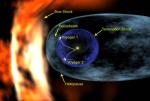 Voyager at 90 AU
20.11.2003
Launched in 1977, Voyager 1 is now about 12 light-hours or 90 astronomical units (AU) from the Sun, making this spacecraft humanity's most distant ambassador to the cosmos. Well beyond the orbits...
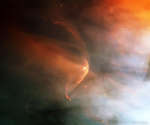 LL Orionis: When Cosmic Winds Collide
22.05.2016
What created this great arc in space? This arcing, graceful structure is actually a bow shock about half a light-year across, created as the wind from young star LL Orionis collides with the Orion Nebula flow.
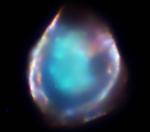 DEM L71: When Small Stars Explode
14.03.2003
Large, massive stars end their furious lives in spectacular supernova explosions -- but small, low mass stars may encounter a similar fate. In fact, instead of simply cooling off and quietly fading away, some white...
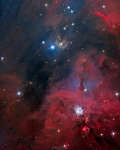 South of Orion
27.01.2022
South of the large star-forming region known as the Orion Nebula, lies bright blue reflection nebula NGC 1999. At the edge of the Orion molecular cloud complex some 1,500 light-years distant, NGC 1999's illumination is provided by the embedded variable star V380 Orionis.
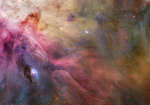 LL Ori and the Orion Nebula
3.02.2013
This esthetic close-up of cosmic clouds and stellar winds features LL Orionis, interacting with the Orion Nebula flow. Adrift in Orion's stellar nursery and still in its formative years, variable star LL Orionis produces a wind more energetic than the wind from our own middle-aged Sun.
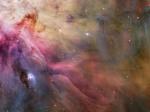 LL Ori and the Orion Nebula
20.01.2006
This esthetic close-up of cosmic clouds and stellar winds features LL Orionis, interacting with the Orion Nebula flow. Adrift in Orion's stellar nursery and still in its formative years, variable star LL Orionis produces a wind more energetic than the wind from our own middle-aged Sun.
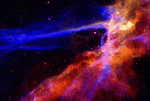 Rampaging Fronts of the Veil Nebula
7.03.1996
A supernova explosion of a high-mass star results in fast moving blast waves. At the front of the waves shown above, ionized gas in the Veil Supernova Remnant rushes out from the explosion, sweeps up material, and breaks up many atoms into constituent ions and electrons.
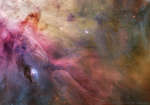 LL Ori and the Orion Nebula
18.02.2018
Stars can make waves in the Orion Nebula's sea of gas and dust. This esthetic close-up of cosmic clouds and stellar winds features LL Orionis, interacting with the Orion Nebula flow. Adrift...
|
January February March April May June July August September |
|||||||||||||||||||||||||||||||||||||||||||||||||