
|
You entered: shock
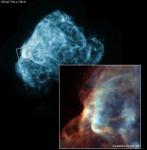 Supernova Remnant and Shock Wave
17.02.2006
A massive star ends life as a supernova, blasting its outer layers back to interstellar space. The spectacular death explosion is initiated by the collapse of what has become an impossibly dense stellar core. Pictured is the expanding supernova remnant Puppis A - one of the brightest sources in the x-ray sky.
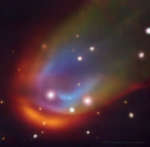 APOD: 2026 February 16 Б Unexplained Shocks Around a White Dwarf Star
16.02.2026
How is RXJ0528+2838 creating such shock waves? A recently discovered white dwarf star, the farther left of the two largest white spots, RXJ0528+2838, was found 730 light-years away from Earth. Most stars...
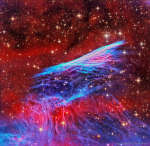 The Pencil Nebula Supernova Shock Wave
14.04.2021
This supernova shock wave plows through interstellar space at over 500,000 kilometers per hour. Near the middle and moving up in this sharply detailed color composite, thin, bright, braided filaments are actually long ripples in a cosmic sheet of glowing gas seen almost edge-on.
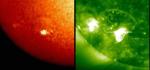 Solar Shock Wave
30.04.1999
On September 24, 1997 a shock wave blasted across the surface of the sun at speeds of 250 to 600 kilometers per second. On planet Earth, observer Barry Reynolds photographed the expanding shock front (left) in the light emitted by hydrogen atoms at the solar surface.
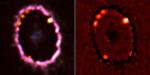 New Shocks For Supernova 1987A
17.02.2000
In February of 1987, astronomers witnessed the brightest supernova of modern times - supernova 1987A in the Large Magellanic Cloud. Mysterious rings of material surrounding the expanding stellar debris were soon emitting a visible glow excited by intense light from the explosion.
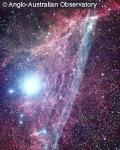 The Vela Supernova Remnant Expands
3.08.1999
The explosion is over but the consequences continue. About eleven thousand years ago a star in the constellation of Vela exploded, creating a strange point of light briefly visible to humans living near the beginning of recorded history.
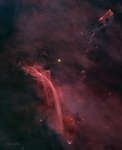 APOD: 2025 December 31 Б HH 222: The Waterfall Nebula
31.12.2025
What created the Waterfall Nebula? The origin is still being researched. The structure, officially designated Herbig-Haro 222, appears in the region of NGC 1999 in the Great Orion Molecular Cloud complex. The elongated gaseous stream stretches about ten light years but appears similar to a long waterfall on Earth.
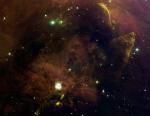 A Panorama of Oddities in Orion A
13.03.2000
New stars, fast jets, and shocked gas clouds all occupy Orion A, a giant molecular cloud just south of the Orion Nebula. The bright object visible below and slightly left of center of this recently released picture is the reflection nebula NGC 1999.
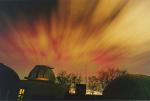 Aurora in Red and Yellow
10.04.2000
The past week brought some spectacular aurora to northern skies. These aurorae were caused by a large interplanetary shock wave that exploded from the Sun on April 4. When the shock wave reached the Earth on April 6, the resulting aurora could be seen in clear skies as far south as North Carolina.
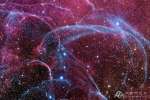 Filaments of the Vela Supernova Remnant
1.10.2013
The explosion is over but the consequences continue. About eleven thousand years ago a star in the constellation of Vela could be seen to explode, creating a strange point of light briefly visible to humans living near the beginning of recorded history.
|
January February March April May June July August September |
|||||||||||||||||||||||||||||||||||||||||||||||||