
|
You entered: rotation
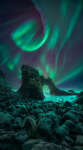 APOD: 2023 January 11 Б Spiral Aurora over Iceland
10.01.2023
The scene may look like a fantasy, but it's really Iceland. The rock arch is named Gatklettur and located on the island's northwest coast. Some of the larger rocks in the foreground span a meter across. The fog over the rocks is really moving waves averaged over long exposures.
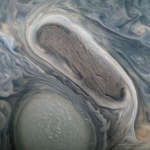 Giant Storms and High Clouds on Jupiter
28.12.2021
What and where are these large ovals? They are rotating storm clouds on Jupiter imaged last month by NASA's Juno spacecraft. In general, higher clouds are lighter in color, and the lightest clouds visible are the relatively small clouds that dot the lower oval.
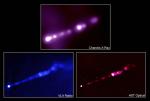 M87 s Energetic Jet
31.10.2001
An energetic jet from the core of giant elliptical galaxy M87 stretches outward for 5,000 light-years. This monstrous jet appears in the panels above to be a knotted and irregular structure, dectected across the spectrum, from x-ray to optical to radio wavelengths.
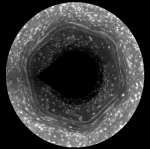 Saturns Hexagon Comes to Light
13.12.2009
Believe it or not, this is the North Pole of Saturn. It is unclear how an unusual hexagonal cloud system that surrounds Saturn's north pole was created, keeps its shape, or how long it will last.
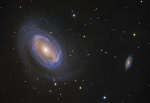 One Armed Spiral Galaxy NGC 4725
30.05.2013
While most spiral galaxies, including our own Milky Way, have two or more spiral arms, NGC 4725 has only one. In this sharp color composite image, the solo spira mirabilis seems to wind from a prominent ring of bluish, newborn star clusters and red tinted star forming regions.
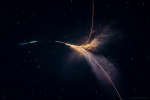 Falcon 9 Boostback
11.03.2020
Short star trails appear in this single 84 second long exposure, taken on March 6 from a rotating planet. The remarkable scene also captures the flight of a Falcon 9 rocket and Dragon cargo spacecraft over Cape Canaveral Air Force Station shortly after launch, on a resupply mission bound for the International Space Station.
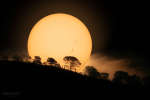 Sun Spot Hill
20.09.2021
Is this giant orange ball about to roll down that tree-lined hill? No, because the giant orange ball is actually the Sun. Our Solar System's central star was captured rising beyond a hill on Earth twelve days ago complete with a delightfully detailed foreground.
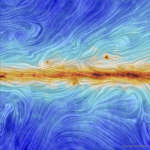 Our Galaxys Magnetic Field from Planck
26.01.2015
What does the magnetic field of our Galaxy look like? It has long been known that a modest magnetic field pervades our Milky Way Galaxy because it is seen to align small dust grains that scatter background light. Only recently, however, has the Earth-orbiting Planck satellite made a high-resolution map of this field.
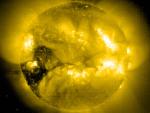 Coronal Holes on the Sun
17.03.2003
The ominous, dark shapes haunting the left side of the Sun are coronal holes -- low density regions extending above the surface where the solar magnetic field opens freely into interplanetary space. Studied extensively from...
 Noctilucent Clouds and Aurora Over Scotland
19.08.2013
Why would the sky still glow after sunset? Besides stars and the band of our Milky Way galaxy, the sky might glow because it contains either noctilucent clouds or aurora. Rare individually, both are visible in the above time lapse movie taken over Caithness, Scotland, UK taken during a single night earlier this month.
|
January February March April May June July August September |
|||||||||||||||||||||||||||||||||||||||||||||||||