
|
You entered: rotation
 APOD: 2024 April 8 Б The Changing Ion Tail of Comet Pons Brooks
8.04.2024
How does a comet tail change? It depends on the comet. The ion tail of Comet 12P/PonsБBrooks has been changing markedly, as detailed in the featured image sequenced over nine days from March 6 to 14 (top to bottom).
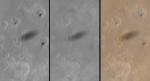 The Shadow of Phobos
29.03.2003
Hurtling through space above the Red Planet, potato-shaped Phobos completes an orbit of Mars in less than eight hours. In fact, since its orbital period is shorter than the planet's rotation period, Mars-based...
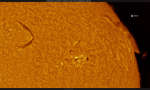 Filaprom on the Western Limb
24.06.2022
A solar filament is an enormous stream of incandescent plasma suspended above the active surface of the Sun by looping magnetic fields. Seen against the solar disk it looks dark only because it's a little cooler, and so slightly dimmer, than the solar photosphere.
 Stereo Jupiter near Opposition
5.12.2024
Jupiter looks sharp in these two rooftop telescope images. Both were captured last year on November 17 from Singapore, planet Earth, about two weeks after Jupiter's 2023 opposition. Climbing high in midnight skies the giant planet was a mere 33.4 light-minutes from Singapore. That's about 4 astronomical units away.
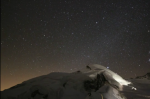 Geostationary Satellites Beyond the Alps
11.04.2012
Why don't those stars move? Stars in the sky will typically appear to rise and set as the Earth turns. Those far to the north or south will appear to circle the pole. If you look closely at the above time-lapse movie, however, there are points of light that appear stationary.
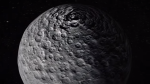 Fly Over Dwarf Planet Ceres
10.06.2015
What would it look like to fly over dwarf planet Ceres? Animators from the German Aerospace Center recently took actual images and height data from NASA's robotic Dawn mission -- currently visiting Ceres -- to generate several fascinating virtual sequences.
 Gemini Observatory North
15.10.2016
It does look like a flying saucer, but this technologically advanced structure is not here to deliver the wise extraterrestrial from the scifi classic movie The Day the Earth Stood Still. It is here to advance our knowledge of the Universe though.
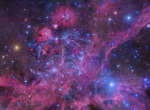 Vela Supernova Remnant Mosaic
10.01.2019
The plane of our Milky Way Galaxy runs through this complex and beautiful skyscape. Seen toward colorful stars near the northwestern edge of the constellation Vela (the Sails), the 16 degree wide, 200 frame...
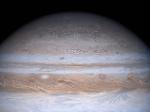 Jupiters Clouds from Cassini
11.09.2005
Gas giant Jupiter is the solar system's largest world with about 320 times the mass of planet Earth. Famous for its Great Red Spot, Jupiter is also known for its regular, equatorial cloud bands, visible in very modest sized telescopes.
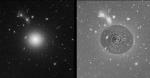 The Secret Spiral Of IC3328
2.06.2000
IC3328 is an otherwise unremarkable dwarf elliptical galaxy about 50 million light-years away in the Virgo cluster. But hidden within IC3328 is a subtle, beautifully symmetric spiral structure! A team of astronomers recently made this totally surprising discovery using detailed digital images from the European Southern Observatory's 8.2 meter Antu telescope.
|
January February March April May |
|||||||||||||||||||||||||||||||||||||||||||||||||