
|
You entered: satellite
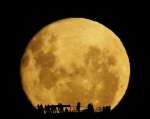 Full Moon Silhouettes
30.01.2013
Have you ever watched the Moon rise? The slow rise of a nearly full moon over a clear horizon can be an impressive sight. One impressive moonrise was imaged two nights ago over Mount Victoria Lookout in Wellington, New Zealand.
 Unusual Plumes Above Mars
23.02.2015
What is creating unusual plumes on Mars? No one is sure. Noted and confirmed by a global contingent of amateur astronomers on photos of the red planet in March 2012, possibly similar plumes have now been found on archived images as far back as 1997.
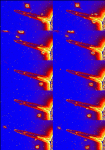 Tracking Saturn's Moons
12.05.1996
These five pairs of Hubble Space Telescope images track some of Saturn's moons as they orbit the ringed planet. A pair of images was taken every 97 minutes on November 21, 1995 with the Wide Field Planetary Camera-2, the normally bright ring system appearing nearly edge-on.
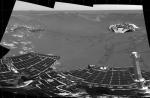 Opportunity Rover Indicates Ancient Mars Was Wet
2.03.2004
Was Mars ever wet enough to support life? To help answer this question, NASA launched two rover missions to the red planet and landed them in regions that satellite images indicated might have been covered with water.
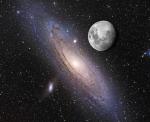 Moon Over Andromeda
27.12.2006
The Great Spiral Galaxy in Andromeda (aka M31), a mere 2.5 million light-years distant, is the closest large spiral to our own Milky Way. Andromeda is visible to the unaided eye as a small...
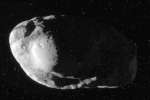 Shepherd Moon Prometheus from Cassini
31.01.2010
Another moon of Saturn has been imaged in detail by the Cassini spacecraft. Orbiting Saturn since 2004, the robotic Cassini got its closest look yet at Saturn's small moon Prometheus last week. Visible...
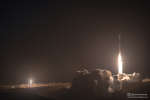 West Coast Launch and Landing
10.10.2018
A SpaceX Falcon 9 rocket launch dazzled viewers along the U.S. west coast after sunset on October 7. Rising from Vandenberg Air Force Base, California, planet Earth, the Falcon 9's first stage then returned to a landing zone some 400 meters from the launch site less than 8 minutes after liftoff.
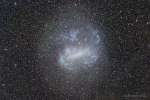 APOD: 2023 March 7 Б Deep Field: The Large Magellanic Cloud
6.03.2023
Is this a spiral galaxy? No. Actually, it is the Large Magellanic Cloud (LMC), the largest satellite galaxy of our own Milky Way Galaxy. The LMC is classified as a dwarf irregular galaxy because of its normally chaotic appearance. In this deep and wide exposure, however, the full extent of the LMC becomes visible.
 Stars in the Infrared Sky
18.09.1996
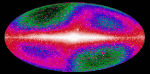
What if you could see infrared light? Because this light is less absorbed by dust than visible light, you could peer into the center of our Milky Way Galaxy. The stars there are normally hidden from direct view by the interstellar dust clouds which line the Galactic plane.
 CMBR Dipole: Speeding Through the Universe
8.03.2008
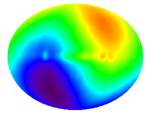
Our Earth is not at rest. The Earth moves around the Sun. The Sun orbits the center of the Milky Way Galaxy. The Milky Way Galaxy orbits in the Local Group of Galaxies. The Local Group falls toward the Virgo Cluster of Galaxies.
|
January February |
|||||||||||||||||||||||||||||||||||||||||||||||||