
|
You entered: satellite
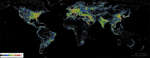 APOD: 2023 March 8 Б Artificial Night Sky Brightness
8.03.2023
Where have all the dim stars gone? From many places on the Earth including major cities, the night sky has been reduced from a fascinating display of thousands of stars to a diffuse glow through which only a few stars are visible.
 APOD: 2026 January 26 Б NGC 55: A Galaxy of Nebulas
26.01.2026
Can you see nebulas in other galaxies? Yes, some nebulas shine brightly enough -- if you know how to look. Clouds of hydrogen and oxygen emit light at very specific colors, and by isolating them, astronomers and astrophotographers can reveal structures that would otherwise be too faint to notice.
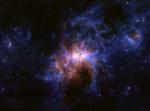 Dusty Environs of Eta Carinae
10.10.2002
Eta Car is a massive star, but it's not as bright as it used to be. Now only easily visible in binoculars or a small telescope, Eta Carinae has a history of spectacular flaring and fading behavior.
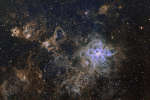 The Cosmic Web of the Tarantula Nebula
11.01.2011
It is the largest and most complex star forming region in the entire galactic neighborhood. Located in the Large Magellanic Cloud, a small satellite galaxy orbiting our Milky Way galaxy, the region's spidery appearance is responsible for its popular name, the Tarantula nebula. This tarantula, however, is about 1,000 light-years across.
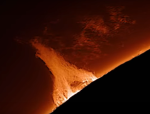 Eiffel Tower Prominence on the Sun
16.02.2022
What's that on the Sun? Although it may look like a flowing version of the Eiffel Tower, it is a solar prominence that is actually much bigger -- about the height of Jupiter.
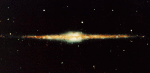 The Milky Way's Center
15.03.1997
Although the Earth is round, our Galaxy appears truly flat. This was shown in dramatic fashion by the COsmic Background Explorer (COBE) satellite which produced this premier view of the central region of our own Milky Way Galaxy in infrared light in1990.
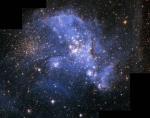 NGC 346 in the Small Magellanic Cloud
18.01.2005
A satellite galaxy of the Milky Way, the Small Magellanic Cloud (SMC) is a wonder of the southern sky, a mere 210,000 light-years distant in the constellation Tucana. Found among the SMC's clusters and nebulae NGC 346 is a star forming region about 200 light-years across, pictured above by the Hubble Space Telescope.
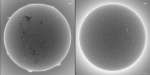 A February without Sunpots
6.03.2019
Where have all the sunspots gone? Last month the total number of spots that crossed our Sun was ... zero. Well below of the long term monthly average, the Sun's surface has become as unusually passive this solar minimum just like it did 11 years ago during the last solar minimum.
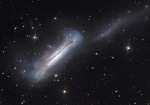 Portrait of NGC 3628
4.06.2020
Sharp telescopic views of NGC 3628 show a puffy galactic disk divided by dark dust lanes. Of course, this deep portrait of the magnificent, edge-on spiral galaxy puts some astronomers in mind of its popular moniker, the Hamburger Galaxy.
 APOD: 2024 May 7 Б Black Hole Accreting with Jet
7.05.2024
What happens when a black hole devours a star? Many details remain unknown, but observations are providing new clues. In 2014, a powerful explosion was recorded by the ground-based robotic telescopes of the All Sky Automated Survey for SuperNovae (Project ASAS-SN), with followed-up observations by instruments including NASA's Earth-orbiting Swift satellite.
|
January February |
|||||||||||||||||||||||||||||||||||||||||||||||||