
|
You entered: satellite
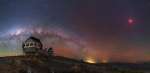 Eclipsed in Southern Skies
30.09.2015
This stunning panorama in southern skies was recorded on the colorful night of September 27/28 from Carngegie Las Campanas Observatory. A diffuse glow and dark rifts of the central Milky Way hang over domes of the twin 6.5 meter Magellan telescopes. But most eye-catching is the deep red glow of the Moon.
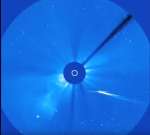 Comet ISON Being Destroyed by the Sun
1.11.2015
Most comets don't survive a close encounter with the Sun. Two years ago this month, though, Comet ISON was thought by some to be big enough to withstand its perilous sungrazing dive. The featured video shows the drama as it was recorded by NASA's Solar and Heliospheric Observatory (SOHO) satellite.
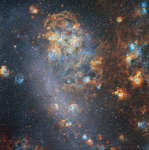 Shell Game in the LMC
28.12.2016
An alluring sight in southern skies, the Large Magellanic Cloud (LMC) is seen here through narrowband filters. The filters are designed to transmit only light emitted by ionized sulfur, hydrogen, and oxygen atoms. Ionized...
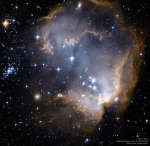 NGC 602 and Beyond
15.05.2021
The clouds may look like an oyster, and the stars like pearls, but look beyond. Near the outskirts of the Small Magellanic Cloud, a satellite galaxy some 200 thousand light-years distant, lies 5 million year young star cluster NGC 602.
 APOD: 2024 October 29 Б NGC 602: Stars Versus Pillars from Webb
28.10.2024
The stars are destroying the pillars. More specifically, some of the newly formed stars in the image center are emitting light so energetic that is evaporating the gas and dust in the surrounding pillars. Simultaneously, the pillars themselves are still trying to form new stars.
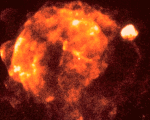 Vela Supernova Remnant in X-ray
12.06.1996
What happens when a star explodes? A huge fireball of hot gas shoots out in all directions. When this gas slams into the existing interstellar medium, it heats up so much it glows in X-rays.
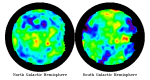 COBE Hotspots:The Oldest Structures Known
8.03.1997
Above are two images of the microwave sky, north and south of our galaxy's equator, based on data from NASA's COsmic Background Explorer (COBE) satellite. After computer processing to remove contributions from nearby objects and the effects of the earth's motion, they show "spots".
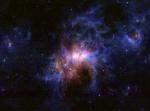 Dusty Environs of Eta Carinae
15.10.2005
Eta Car is a massive star, but it's not as bright as it used to be. Now only easily visible in binoculars or a small telescope, Eta Carinae has a history of spectacular flaring and fading behavior.
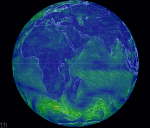 The Winds of Earth
9.10.2016
Which way is the wind blowing? The featured map can tell you this and much more, no matter your location on planet Earth. The dynamic map displays supercomputer forecasts drawn from multiple sources of global satellite data updated every three hours.
 APOD: 2024 October 13 Б Aurora Timelapse Over Italian Alps
12.10.2024
Did you see last night's aurora? This question was relevant around much of the world a few days ago because a powerful auroral storm became visible unusually far from the Earth's poles.
|
January February |
|||||||||||||||||||||||||||||||||||||||||||||||||