
|
You entered: satellite
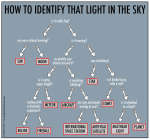 How to Identify that Light in the Sky
14.11.2021
What is that light in the sky? Perhaps one of humanity's more common questions, an answer may result from a few quick observations. For example -- is it moving or blinking?
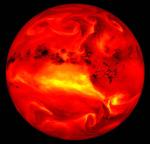 The Water Vapor Channel
23.03.2002
What alien planet's bizarre landscape lurks below these fiery-looking clouds? It's only planet Earth, of course ... as seen on the Water Vapor Channel. Hourly, images like this one (an infrared image shown in false-color) are brought to you by the orbiting Geostationary Operational Environmental Satellites' (GOES) multi-channel imagers.
 Large Sunspot Groups 10484 and 10486
27.10.2003
Two unusually large sunspot groups are now crossing the face of the Sun. Each group, roughly the size of Jupiter, is unusual not only for its size but because it is appearing over three years after solar maximum, the peak of solar surface activity.
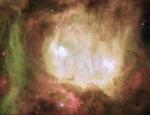 Halloween and the Ghost Head Nebula
31.10.2004
Halloween's origin is ancient and astronomical. Since the fifth century BC, Halloween has been celebrated as a cross-quarter day, a day halfway between an equinox (equal day / equal night) and a solstice (minimum day / maximum night in the northern hemisphere). With our modern calendar, however, the real cross-quarter day will occur next week.
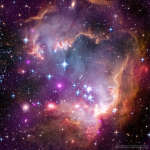 NGC 602 and Beyond
24.03.2018
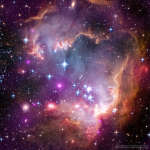
Near the outskirts of the Small Magellanic Cloud, a satellite galaxy some 200 thousand light-years distant, lies 5 million year young star cluster NGC 602. Surrounded by natal gas and dust...
 NGC 602 and Beyond
11.01.2020
Near the outskirts of the Small Magellanic Cloud, a satellite galaxy some 200 thousand light-years distant, lies 5 million year young star cluster NGC 602. Surrounded by natal gas and dust...
 Io: Moon Over Jupiter
8.04.2012
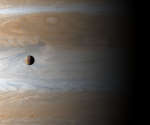
How big is Jupiter's moon Io? The most volcanic body in the Solar System, Io (usually pronounced "EYE-oh") is 3,600 kilometers in diameter, about the size of planet Earth's single large natural satellite.
 Messier 63: The Sunflower Galaxy
12.07.2017
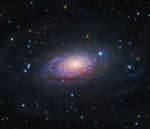
A bright spiral galaxy of the northern sky, Messier 63 is about 25 million light-years distant in the loyal constellation Canes Venatici. Also cataloged as NGC 5055, the majestic island universe is nearly 100,000 light-years across. That's about the size of our own Milky Way Galaxy.
 The Gaia Stars of M15
28.03.2019
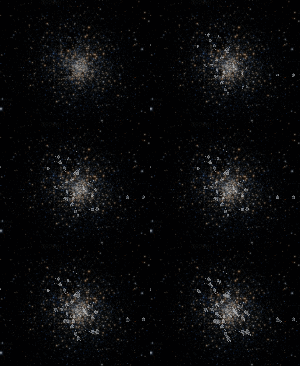
Messier 15 is a 13 billion year old relic of the early formative years of our galaxy, one of about 170 globular star clusters that still roam the halo of the Milky Way. About 200 light-years in diameter, it lies about 35,000 light years away toward the constellation Pegasus.
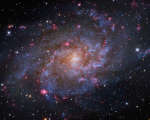 M33: The Triangulum Galaxy
31.12.2019
The small, northern constellation Triangulum harbors this magnificent face-on spiral galaxy, M33. Its popular names include the Pinwheel Galaxy or just the Triangulum Galaxy. M33 is over 50,000 light-years in diameter, third largest in the Local Group of galaxies after the Andromeda Galaxy (M31), and our own Milky Way.
|
January February |
|||||||||||||||||||||||||||||||||||||||||||||||||