
|
You entered: satellite
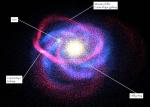 Canis Major Dwarf: A New Closest Galaxy
17.11.2003
What is the closest galaxy to the Milky Way? The new answer to this old question is the Canis Major dwarf galaxy. For many years astronomers thought the Large Magellan Cloud (LMC) was closest, but its title was supplanted in 1994 by the Sagittarius dwarf galaxy.
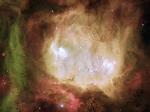 Halloween and the Ghost Head Nebula
31.10.2007
Halloween's origin is ancient and astronomical. Since the fifth century BC, Halloween has been celebrated as a cross-quarter day, a day halfway between an equinox (equal day / equal night) and a solstice (minimum day / maximum night in the northern hemisphere). With our modern calendar, however, the real cross-quarter day will occur next week.
 Biomarker Phosphine Discovered in the Atmosphere of Venus
15.09.2020
Could there be life floating in the atmosphere of Venus? Although Earth's planetary neighbor has a surface considered too extreme for any known lifeform, Venus' upper atmosphere may be sufficiently mild for tiny airborne microbes. This usually disfavored prospect took an unexpected upturn yesterday with the announcement of the discovery of Venusian phosphine.
 Small Moon Deimos
7.09.2024
Mars has two tiny moons, Phobos and Deimos, named for the figures in Greek mythology Fear and Panic. Detailed surface views of smaller moon Deimos are shown in both these panels. The images were taken in 2009, by the HiRISE camera on board the Mars Reconnaissance Orbiter spacecraft, NASA's long-lived interplanetary internet satellite.
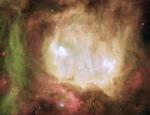 Halloween and the Ghost Head Nebula
31.10.2001
Halloween's origin is ancient and astronomical. Since the fifth century BC, Halloween has been celebrated as a cross-quarter day, a day halfway between an equinox (equal day / equal night) and a solstice (minimum day / maximum night in the northern hemisphere). With our modern calendar, however, the real cross-quarter day will occur next week.
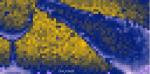 Vintage Gamma Rays
6.04.2002
Gamma-rays are the most energetic form of electromagnetic radiation. But these high energy photons penetrate and interact in normal materials and cannot be focused by lenses and mirrors like those in optical telescopes. So how do you make an image in gamma-ray light?
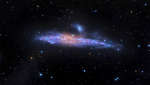 Star Streams and the Whale Galaxy
19.12.2015
NGC 4631 is a spiral galaxy found only 25 million light-years away, toward the well-trained northern constellation Canes Venatici. Seen ege-on, the galaxy is similar in size to the Milky Way. Its distorted wedge shape suggests to some a cosmic herring and to others its popular moniker, The Whale Galaxy.
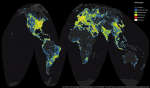 The New World Atlas of Artificial Sky Brightness
30.06.2016
How far are you from a naturally dark night sky? In increasing steps, this world map (medium | large) shows the effect of artificial night sky brightness on the visual appearance of the night sky. The brightness was modeled using high resolution satellite data and fit to thousands of night sky brightness measurements in recent work.
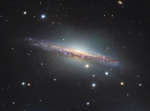 NGC 1055 Close up
9.11.2017
Big, beautiful spiral galaxy NGC 1055 is a dominant member of a small galaxy group a mere 60 million light-years away toward the aquatically intimidating constellation Cetus. Seen edge-on, the island universe spans over 100,000 light-years, a little larger than our own Milky Way.
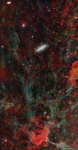 The Deep Sky Toward Andromeda
8.09.2021
What surrounds the Andromeda galaxy? Out in space, Andromeda (M31) is closely surrounded by several small satellite galaxies, and further out it is part of the Local Group of Galaxies -- of which our Milky Way galaxy is also a member.
|
January February |
|||||||||||||||||||||||||||||||||||||||||||||||||