
|
You entered: satellite
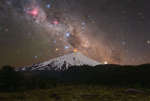 Southern Cross over Chilean Volcano
25.01.2021
Have you ever seen the Southern Cross? This famous four-star icon is best seen from Earth's Southern Hemisphere. The featured image was taken last month in Chile and captures the Southern Cross just to the left of erupting Villarrica, one of the most active volcanos in our Solar System.
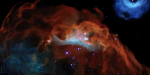 Journey into the Cosmic Reef
18.05.2020
What would you see if you could fly into the Cosmic Reef? The nebular cloud NGC 2014 appear to some like an ocean reef that resides in the sky, specifically in the LMC, the largest satellite galaxy of our Milky Way Galaxy.
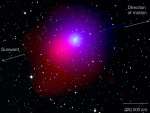 The Swift View of Comet Lulin
21.02.2009
Now growing brighter, Comet Lulin is headed for its closest approach to planet Earth early next week. But the comet's greenish glow, familiar to earthbound skygazers, is replaced by false colors in this premier view from the orbiting Swift satellite.
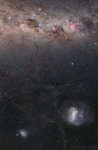 Galaxies and the South Celestial Pole
1.01.2021
The South Celestial Pole is easy to spot in star trail images of the southern sky. The extension of Earth's axis of rotation to the south, it's at the center of all the southern star trail arcs.
 NASAs X 43A Scramjet Sets Air Speed Record
29.03.2004
Using oxygen from the air itself, a NASA experimental jet propelled itself past Mach 7 in the atmosphere above the Pacific Ocean this weekend. The small automated X-43A Hyper-X craft was dropped from a huge converted B-52 bomber and then accelerated by a standard Pegasus rocket.
 APOD: 2025 June 23 Б W5: Pillars of Star Formation
23.06.2025
How do stars form? Images of the star forming region W5 like those in the infrared by NASA's Wide Field Infrared Survey Explorer (WISE, later NEOWISE) satellite provide clear clues with indications that massive stars near the center of empty cavities are older than stars near the edges.
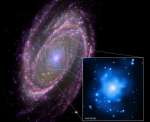 M81: Feeding a Black Hole
27.06.2008
This impressive color composite shows spiral galaxy M81 across the electromagnetic spectrum. It combines X-ray data (blue) from the Chandra Observatory, infrared data (pink) from the Spitzer Space Telescope, and an ultraviolet image (purple) from the GALEX satellite, with a visible light (green) Hubble image.
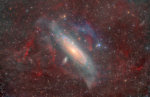 APOD: 2026 June 3 Б Andromeda Through Gas and Dust
3.06.2026
Over 1000 years ago, Persian astronomer Abd al-Rahman al-Sufi published humanityБs oldest known record of the Andromeda Galaxy in "The Book of Fixed Stars" (Bodleian Library MS. Marsh 144 p. 167). 800 years later, Andromeda became the 31st entry in Charles MessierБs "Catalogue of Nebulae and Star Clusters".
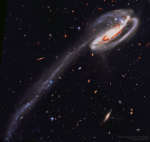 The Tadpole Galaxy from Hubble
21.06.2021
Why does this galaxy have such a long tail? In this stunning vista, based on image data from the Hubble Legacy Archive, distant galaxies form a dramatic backdrop for disrupted spiral galaxy Arp 188, the Tadpole Galaxy. The cosmic tadpole is a mere 420 million light-years distant toward the northern constellation of the Dragon (Draco).
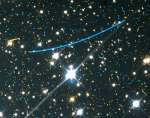 Asteroids in the Distance
10.02.2013
Rocks from space hit Earth every day. The larger the rock, though, the less often Earth is struck. Many kilograms of space dust pitter to Earth daily. Larger bits appear initially as a bright meteor. Baseball-sized rocks and ice-balls streak through our atmosphere daily, most evaporating quickly to nothing.
|
January February March April May June July August September |
|||||||||||||||||||||||||||||||||||||||||||||||||