
|
You entered: satellite
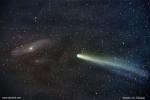 A Galaxy is not a Comet
12.04.2002
This gorgeous galaxy and comet portrait was recorded on April 5th in the skies over the Oriental Pyrenees near Figueres, Spain. From a site above 1,100 meters, astrophotographer Juan Carlos Casado used...
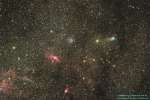 Comet Lemmon and the Deep Sky
20.07.2013
Now sweeping high above the ecliptic plane, Comet Lemmon has faded dramatically in planet Earth's night sky as it heads for the outer solar system. Some 16 light-minutes (2 AU) from...
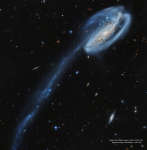 Arp 188 and the Tadpole's Tail
11.12.2018
Why does this galaxy have such a long tail? In this stunning vista, based on image data from the Hubble Legacy Archive, distant galaxies form a dramatic backdrop for disrupted spiral galaxy Arp 188, the Tadpole Galaxy. The cosmic tadpole is a mere 420 million light-years distant toward the northern constellation of the Dragon (Draco).
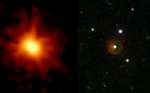 Across the Universe
28.03.2008
How far can you see? Even the faintest stars visible to the eye are merely hundreds or thousands of light-years distant, all well within our own Milky Way Galaxy. Of course, if you know where to look you can also spot the Andromeda Galaxy as a pale, fuzzy cloud, around 2.5 million light-years away.
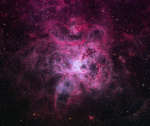 The Tarantula Nebula
17.11.2018
The Tarantula Nebula, also known as 30 Doradus, is more than a thousand light-years in diameter, a giant star forming region within nearby satellite galaxy the Large Magellanic Cloud. About 180 thousand light-years away, it's the largest, most violent star forming region known in the whole Local Group of galaxies.
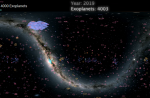 4000 Exoplanets
14.08.2022
Over 4000 planets are now known to exist outside our Solar System. Known as exoplanets, this milestone was passed last month, as recorded by NASA's Exoplanet Archive. The featured video highlights these exoplanets in sound and light, starting chronologically from the first confirmed detection in 1992 and continuing into 2019.
 APOD: 2025 May 4 Б Spin up of a Supermassive Black Hole
4.05.2025
How fast can a black hole spin? If any object made of regular matter spins too fast -- it breaks apart. But a black hole might not be able to break apart -- and its maximum spin rate is really unknown.
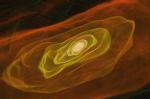 Zooming in on the First Stars
10.06.2003
What became of the first stars? No known stars appear to be composed of truly primordial gas -- all of the stars around us have too many heavy elements. Our own Sun is thought to be a third generation star, with many second-generation stars seen in globular clusters.
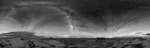 A Dark Sky Over Sequoia National Park
27.08.2009
Scroll right to take in the view from the highest summit in the contiguous USA. The above 360-degree digitally stitched panorama, taken in mid-July, shows the view from 4,400-meter high Mt. Whitney in Sequoia National Park, California. In the foreground, angular boulders populate Mt.
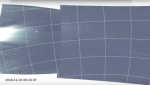 Looking Sideways from the Parker Solar Probe
9.12.2019
Everybody sees the Sun. Nobody's been there. Starting in 2018 though, NASA launched the robotic Parker Solar Probe (PSP) to investigate regions near to the Sun for the first time. The PSP's looping orbit brings it yet closer to the Sun each time around -- every few months.
|
January February March April May June July August September |
|||||||||||||||||||||||||||||||||||||||||||||||||