
|
You entered: satellite
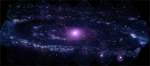 Ultraviolet Andromeda
17.09.2009
Taken by a telescope onboard NASA's Swift satellite, this stunning vista represents the highest resolution image ever made of the Andromeda Galaxy (aka M31) - at ultraviolet wavelengths. The mosaic is composed of 330 individual images covering a region 200,000 light-years wide.
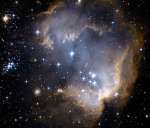 NGC 602 and Beyond
3.04.2010
Near the outskirts of the Small Magellanic Cloud, a satellite galaxy some 200 thousand light-years distant, lies 5 million year young star cluster NGC 602. Surrounded by natal gas and dust, NGC 602 is featured in this stunning Hubble image of the region.
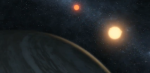 Kepler 16b: A Planet with Two Suns
20.09.2011
If you stay up long enough, you can watch both suns set. Such might be a common adage from beings floating in the atmosphere of Kepler 16b, a planet recently discovered by the space-based Kepler satellite. The above animated video shows how the planetary system might look to a visiting spaceship.
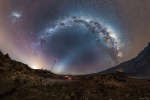 Milky Way and Zodiacal Light over Chile
9.03.2020
What is the band of light connecting the ground to the Milky Way? Zodiacal light -- a stream of dust that orbits the Sun in the inner Solar System. It is most easily seen just before sunrise, where it has been called a false dawn, or just after sunset.
 APOD: 2025 May 9 Б IXPE Explores a Black Hole Jet
9.05.2025
How do black holes create X-rays? Answering this long-standing question was significantly advanced recently with data taken by NASAБs IXPE satellite. X-rays cannot exit a black hole, but they can be created in the energetic environment nearby, in particular by a jet of particles moving outward.
 APOD: 2025 June 19 Б NGC 3521: Galaxy in a Bubble
19.06.2025
Gorgeous spiral galaxy NGC 3521 is a mere 35 million light-years away, toward the northern springtime constellation Leo. Relatively bright in planet Earth's sky, NGC 3521 is easily visible in small telescopes but often overlooked by amateur imagers in favor of other Leo spiral galaxies, like M66 and M65.
 A Twisted Solar Eruptive Prominence
23.02.2003
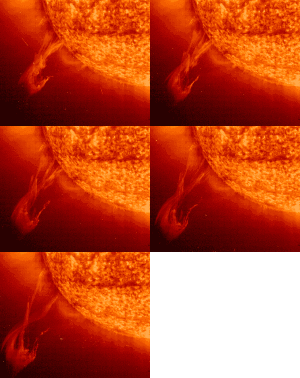
A huge eruptive prominence is seen moving out from our Sun in this condensed half-hour time-lapse sequence. Ten Earths could easily fit in the "claw" of this seemingly solar monster. This large prominence, though, is significant not only for its size, but its shape.
 GRACE Maps the Gravity of Earth
23.07.2003
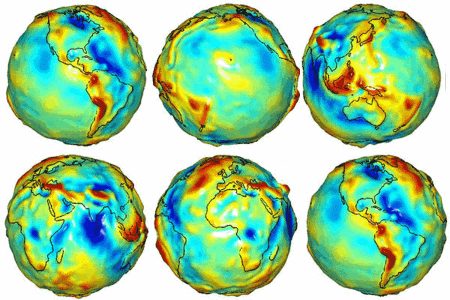
Why do some places on Earth have higher gravity than others? Sometimes the reason is unknown. To help better understand the Earth's surface, slight distance changes between a pair of identically orbiting satellites named GRACE have been used to create the best ever map of Earth's gravitational field.
 APOD: 2006 October 1- Earth at Night
1.10.2006
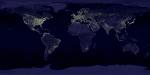
This is what the Earth looks like at night. Can you find your favorite country or city? Surprisingly, city lights make this task quite possible. Human-made lights highlight particularly developed or populated areas of the Earth's surface, including the seaboards of Europe, the eastern United States, and Japan.
 The First Explorer
1.02.2008
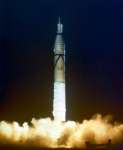
Fifty years ago (on January 31, 1958) the First Explorer, was launched into Earth orbit by the Army Ballistic Missile Agency. Inaugurating the era of space exploration for the United States, Explorer I was a thirty pound satellite that carried instruments to measure temperatures, and micrometeorite impacts, along with an experiment designed by James A.
|
January February |
|||||||||||||||||||||||||||||||||||||||||||||||||