
|
You entered: satellite
 Andromeda and Friends
15.11.2025
This magnificent extragalactic skyscape looks toward the Andromeda Galaxy, the closest large spiral galaxy to the Milky Way. It also accomplishes a Messier catalog trifecta by including Andromeda, cataloged as Messier 31 (M31), along with Messier 32 (M32), and Messier 110 (M110) in the same telescopic field of view.
 Beta Pictoris Revisited
28.11.1997
In the early 1980s, Beta Pictoris became one of the most important stars in the sky. Satellite and ground-based telescopic observations revealed the presence of a surrounding outer disk of material and an inner "clear" zone about the size of our solar system - strong evidence for the formation of planets.
 Eclipsed Moon in Infrared
23.04.2005
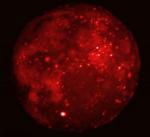
In September of 1996, the Midcourse Space Experiment (MSX) satellite had a spectacular view of a total lunar eclipse from Earth orbit. SPIRIT III, an on board infrared telescope, was used to repeatedly image the moon during the eclipse.
 NGC 602 and Beyond
25.10.2008
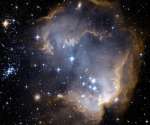
Near the outskirts of the Small Magellanic Cloud, a satellite galaxy some 200 thousand light-years distant, lies 5 million year young star cluster NGC 602. Surrounded by natal gas and dust, NGC 602 is featured in this stunning Hubble image of the region.
 The Known Universe
20.01.2010
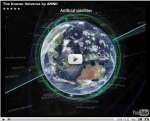
What would it look like to travel across the known universe? To help humanity visualize this, the American Museum of Natural History has produced a modern movie featuring many visual highlights of such a trip.
 NGC 1055: Galaxy in a Box
24.04.2010
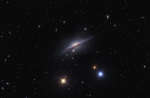
Big, beautiful spiral galaxy NGC 1055 is a dominant member of a small galaxy group a mere 60 million light-years away toward the intimidating constellation Cetus. Seen edge-on, the island universe spans about 100,000 light-years, similar in size to our own Milky Way.
 NGC 2419 Intergalactic Wanderer
4.06.2015
Three objects stand out in this thoughtful telescopic image, a view toward the mostly stealthy constellation Lynx. The two brightest (the spiky ones) are nearby stars. The third is the remote globular star cluster NGC 2419, at distance of nearly 300,000 light-years.
 APOD: 2025 January 15 Б Wolf Moon Engulfs Mars
15.01.2025
Does the Moon ever engulf Mars? Yes, but only in the sense that it moves in front, which happens on rare occasions. This happened just yesterday, though, as seen from some locations in North America and western Africa.
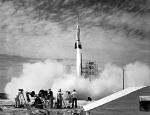 The First Rocket Launch from Cape Canaveral
22.10.2001
A new chapter in space flight began on 1950 July with the launch of the first rocket from Cape Canaveral, Florida: the Bumper 2. Shown above, the Bumper 2 was an ambitious two-stage rocket program that topped a V-2 missile base with a WAC Corporal rocket.
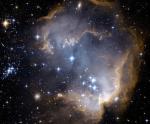 NGC 602 and Beyond
10.01.2007
Near the outskirts of the Small Magellanic Cloud, a satellite galaxy some 200 thousand light-years distant, lies 5 million year young star cluster NGC 602. Surrounded by natal gas and dust, NGC 602 is featured in this stunning Hubble image of the region.
|
January February |
|||||||||||||||||||||||||||||||||||||||||||||||||