
|
You entered: image
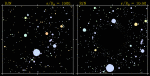 Too Close to a Black Hole
4.01.1997
What would you see if you went right up to a black hole? Above are two computer generated pictures highlighting how strange things would look. On the left is a normal star field containing the constellation Orion. Notice the three stars of nearly equal brightness that make up Orion's Belt.
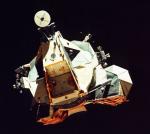 Apollo 17s Moonship
15.04.1999
Awkward and angular looking, Apollo 17's lunar module Challenger was designed for flight in the vacuum of space. This sharp picture from the command module America, shows Challenger's ascent stage in lunar orbit.
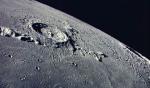 Bats And The Barren Moon
30.10.1998
This picture, taken as the Apollo 17 astronauts orbited the Moon in 1972, depicts the stark lunar surface around the Eratosthenes and Copernicus craters. Images of a Moon devoid of life are familiar to denizens of the space age.
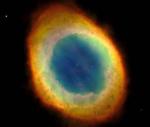 The Ring
6.01.1999
Except for the Rings of Saturn, The Ring Nebula (M57) is probably the most famous celestial band. This planetary nebula's simple, graceful appearance is thought to be due to perspective -- our view from planet Earth looking straight into what is actually a barrel-shaped cloud of gas shrugged off by a dying central star.
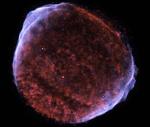 SN 1006: Supernova Remnant in X Rays
25.12.2005
This huge puff ball was once a star. One thousand years ago, in the year 1006, a new star was recorded in the sky that today we know was really an existing star exploding.
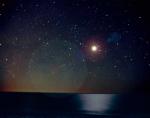 1006 AD: Supernova in the Sky
30.04.2006
A new star, likely the brightest supernova in recorded human history, appeared in planet Earth's sky about 1,000 years ago today, in 1006 AD. The expanding debris cloud from the stellar explosion is still visible to modern astronomers, but what did the supernova look like in 1006?
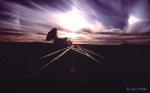 Sundogs over the VLA
23.08.1999
What if you woke up one morning and saw more than one Sun in the sky? Most probably, you would be seeing sundogs, extra-images of the Sun created by falling ice-crystals in the Earth's atmosphere. As water freezes in the atmosphere, small, flat, six-sided, ice crystals might be formed.
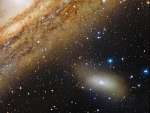 M110: Satellite of the Andromeda Galaxy
9.09.2008
Our Milky Way Galaxy is not alone. It is part of a gathering of about 25 galaxies known as the Local Group. Members include the Great Andromeda Galaxy (M31), M32, M33, the Large Magellanic Cloud, the Small Magellanic Cloud, Dwingeloo 1, several small irregular galaxies, and many dwarf elliptical and dwarf spheroidal galaxies.
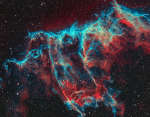 A Spectre in the Eastern Veil
31.10.2008
Menacing flying forms and garish colors are a mark of the Halloween season. They also stand out in this cosmic close-up of the eastern Veil Nebula. The Veil Nebula itself is a large supernova remnant, the expanding debris cloud from the death explosion of a massive star.
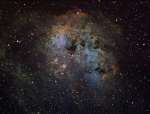 IC 410 and NGC 1893
16.01.2009
Dusty emission nebula IC 410 lies about 12,000 light-years away in the northern constellation Auriga. The cloud of glowing gas is over 100 light-years across, sculpted by stellar winds and radiation from embedded open star cluster NGC 1893.
|
January February March April May June July August September |
|||||||||||||||||||||||||||||||||||||||||||||||||