
|
You entered: image
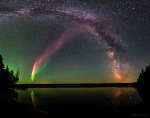 A Glowing STEVE and the Milky Way
17.11.2020
What's creating these long glowing streaks in the sky? No one is sure. Known as Strong Thermal Emission Velocity Enhancements (STEVEs), these luminous light-purple sky ribbons may resemble regular auroras, but recent research reveals significant differences.
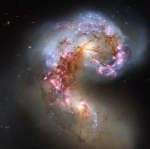 The Antennae Galaxies in Collision
3.12.2020
Sixty million light-years away toward the southerly constellation Corvus, these two large galaxies are colliding. The cosmic train wreck captured in stunning detail in this Hubble Space Telescope snapshot takes hundreds of millions of years to play out. Cataloged as NGC 4038 and NGC 4039, the galaxies' individual stars don't often collide though.
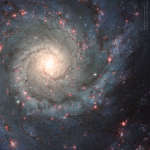 A Perfect Spiral
13.08.2021
If not perfect then this spiral galaxy is at least one of the most photogenic. An island universe of about 100 billion stars, 32 million light-years away toward the constellation Pisces, M74 presents a gorgeous face-on view.
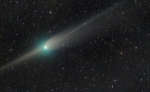 Comet ZTF: Orbital Plane Crossing
27.01.2023
The current darling of the northern night, Comet C/2022 E3 ZTF is captured in this telescopic image from a dark sky location at June Lake, California. Of course Comet ZTF has been growing brighter in recent days, headed for its closest approach to Earth on February 1.
 APOD: 2024 September 23 Б Comet Tsuchinshan ATLAS Approaches
23.09.2024
What will happen as this already bright comet approaches? Optimistic predictions have Comet C/2023 A3 (TsuchinshanБATLAS) briefly becoming easily visible to the unaided eye -- although the future brightness of comets are notoriously hard to predict, and this comet may even break up in warming sunlight.
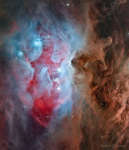 APOD: 2026 February 2 Б Orion: The Running Man Nebula
2.02.2026
What part of Orion is this? Just north of the famous Orion Nebula is a picturesque star forming region in Orion's Sword that contains a lot of intricate dust -- some of which appears blue because it reflects the light of bright embedded stars.
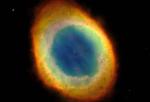 M57: The Ring Nebula
16.07.2000
Except for the rings of Saturn, The Ring Nebula (M57) is probably the most famous celestial band. This planetary nebula's simple, graceful appearance is thought to be due to perspective -- our view from planet Earth looking straight into what is actually a barrel-shaped cloud of gas shrugged off by a dying central star.
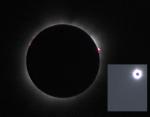 Eclipse in African Skies
22.06.2001
Yesterday, for a brief few minutes, a total eclipse of the Sun brought darkness to southern Africa's daytime skies. During this first total solar eclipse of the third millennium webcast sites were swamped, but sun-watchers along the eclipse path enjoyed clear weather and reported fantastic views.
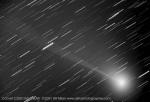 C 2001 A2 (LINEAR): Comet
5.07.2001
Comet C/2001 A2 (LINEAR) has crossed the celestial equator and is heading north. Outward bound, this primordial piece of the solar system is still just visible to the unaided eye and can now be sighted by northern hemisphere skygazers as it moves through the constellation Pisces.
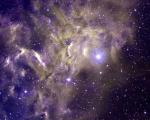 AE Aurigae: The Flaming Star
4.12.2001
Is star AE Aurigae on fire? Although surrounded by what may look like smoke, the object known as the "flaming star" creates energy primarily by nuclear fusion, like other stars. Fire, typically defined...
|
January February March April May June July August September |
|||||||||||||||||||||||||||||||||||||||||||||||||