
|
You entered: image
 To the Moon
24.02.2024
Intuitive Machines' robotic lander Odysseus has accomplished the first U.S. landing on the Moon since the Apollo 17 mission in 1972. Launched on a SpaceX rocket on February 15, the phone booth sized lander reached lunar orbit on the 21st and touched down on the lunar surface at 6:23 pm ET on February 22nd.
 APOD: 2024 July 28 Б Sun Dance
28.07.2024
Sometimes, the surface of our Sun seems to dance. In the middle of 2012, for example, NASA's Sun-orbiting Solar Dynamic Observatory spacecraft imaged an impressive prominence that seemed to perform a running dive roll like an acrobatic dancer.
 APOD: 2024 November 17 Б LDN 1471: A Windblown Star Cavity
17.11.2024
What is the cause of this unusual parabolic structure? This illuminated cavity, known as LDN 1471, was created by a newly forming star, seen as the bright source at the peak of the parabola.
 APOD: 2025 July 30 Б Coronal Loops on the Sun
30.07.2025
Our Sun frequently erupts in loops. Hot solar plasma jumps off the Sun's surface into prominences, with the most common type of prominence being a simple loop. The loop shape originates from the Sun's magnetic field, which is traced by spiraling electrons and protons.
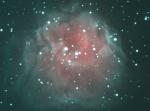 Sharpless 212 in Hydrogen and Sulfur
18.12.2001
Where do the most massive stars form? Observational evidence indicates that the outskirts of developing open clusters of stars are primary locations. Pictured above is one such open cluster: Sharpless 212. Visible in the image center are massive stars in the open cluster.
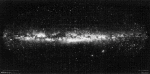 7,000 Stars And The Milky Way
13.02.1996
This panorama view of the sky is really a drawing. It was made in the 1940s under the supervision of astronomer Knut Lundmark at the Lund Observatory in Sweden. To create the picture, draftsmen...
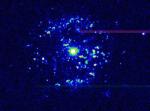 T Pyxidis: Recurrent Nova
25.09.1997
What happens when a thermonuclear blast occurs on the surface of a white dwarf star? Over the years astronomers have watched (at a safe distance ...) as, 6,000 light years from Earth in the southern constellation Pyxis, a binary star known as T Pyxidis repeatedly produces these fearsome explosions.
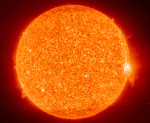 Helios Helium
16.05.1998
This image of the relatively quiet Sun was made using ultraviolet light emitted by ionized Helium atoms in the Solar chromosphere. Helium was first discovered in the Sun in 1868, its name fittingly derived from from the Greek word Helios, meaning Sun.
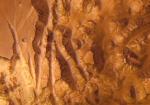 Valles Marineris from Mars Express
24.01.2004
Looking down from orbit on January 14, ESA's Mars Express spacecraft scanned a 1700 by 65 kilometer swath across Valles Marineris - the Grand Canyon of Mars - with its remarkable High Resolution Stereo Camera.
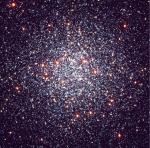 M55: Globular Star Cluster
18.09.2004
The fifty-fifth entry in Charles Messier's catalog, M55 is a large and lovely globular cluster of around 100,000 stars. Only 20,000 light-years away in the constellation Sagittarius, M55 appears to earth-bound observers to be nearly 2/3 the size of the full moon.
|
January February March April May June July August September |
|||||||||||||||||||||||||||||||||||||||||||||||||