
|
You entered: Earth
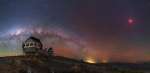 Eclipsed in Southern Skies
1.10.2015
This stunning panorama in southern skies was recorded on the colorful night of September 27/28 from Carngegie Las Campanas Observatory. A diffuse glow and dark rifts of the central Milky Way hang over domes of the twin 6.5 meter Magellan telescopes. But most eye-catching is the deep red glow of the Moon.
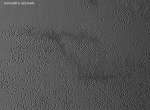 Unusual Pits Discovered on Pluto
25.11.2015
Why are there unusual pits on Pluto? The indentations were discovered during the New Horizons spacecraft's flyby of the dwarf planet in July. The largest pits span a kilometer across and dip tens...
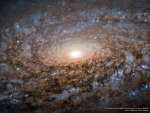 In the Center of Spiral Galaxy NGC 3521
30.11.2015
This huge swirling mass of stars, gas, and dust occurs near the center of a nearby spiral galaxy. Gorgeous spiral NGC 3521 is a mere 35 million light-years distant, toward the constellation Leo. Spanning some 50,000 light-years, its central region is shown in this dramatic image, constructed from data from the Hubble Space Telescope.
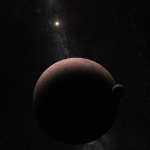 Moon over Makemake
30.04.2016
Makemake, second brightest dwarf planet of the Kuiper belt, has a moon. Nicknamed MK2, Makemake's moon reflects sunlight with a charcoal-dark surface, about 1,300 times fainter than its parent body. Still...
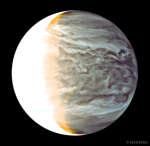 Night on Venus in Infrared from Orbiting Akatsuki
7.06.2016
Why is Venus so different from Earth? To help find out, Japan launched the robotic Akatsuki spacecraft which entered orbit around Venus late last year after an unplanned five-year adventure around the inner Solar System.
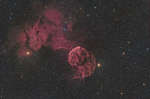 Sharpless 249 and the Jellyfish Nebula
23.03.2018
Normally faint and elusive, the Jellyfish Nebula is caught in this alluring telescopic image. Centered in the scene it's anchored right and left by two bright stars, Mu and Eta Geminorum, at the foot of the celestial twin. The Jellyfish Nebula is the brighter arcing ridge of emission with dangling tentacles.
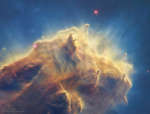 Star Formation in the Eagle Nebula
14.03.2022
Where do stars form? One place, star forming regions known as "EGGs", are being uncovered at the end of this giant pillar of gas and dust in the Eagle Nebula (M16). Short for evaporating gaseous globules, EGGs are dense regions of mostly molecular hydrogen gas that fragment and gravitationally collapse to form stars.
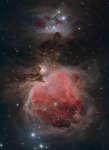 Orion and the Running Man
10.03.2023
Few cosmic vistas excite the imagination like The Great Nebula in Orion. Visible as a faint celestial smudge to the naked-eye, the nearest large star-forming region sprawls across this sharp telescopic image, recorded on a cold January night in dark skies from West Virginia, planet Earth.
 APOD: 2024 January 21 Б The Upper Michigan Blizzard of 1938
21.01.2024
Yes, but can your blizzard do this? In the Upper Peninsula of Michigan's Storm of the Century in 1938, some snow drifts reached the level of utility poles. Nearly a meter of new and unexpected snow fell over two days in a storm that started 86 years ago this week.
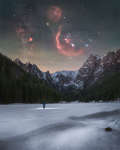 APOD: 2026 January 27 Б Orions Treasures over Snowy Mountains
27.01.2026
Rising over a frozen valley in the Tatra Mountains, the familiar stars and nebulas of Orion dominate this wide-field nightscape. The featured deep photo was taken in southern Poland's highest mountain range last month, where dark skies and alpine terrain combined to reveal both Earth's rugged beauty and the structure of our galaxy.
|
January February March April May June July August September October |
|||||||||||||||||||||||||||||||||||||||||||||||||