
|
You entered: Earth
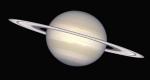 Natural Saturn On The Cassini Cruise
29.01.2000
What could you see approaching Saturn aboard an interplanetary cruise ship? Your view would likely resemble this subtly shaded image of the gorgeous ringed gas giant. Processed by the Hubble Heritage project, the picture...
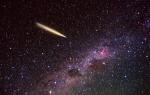 Mystery Over Australia
22.02.2007
Place your cursor on this stunning view of dark skies over western Australia to highlight wonders of the southern Milky Way -- including the famous Southern Cross, the dark Coal Sack Nebula, and bright reddish emission regions surrounding massive star Eta Carinae.
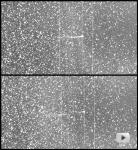 Comet Encke s Tail Ripped off
3.10.2007
Swinging inside the orbit of Mercury, on April 20th periodic comet Encke encountered a blast from the Sun in the form of a Coronal Mass Ejection (CME). When CMEs, enormous clouds of energetic particles ejected from the Sun, slam into Earth's magnetosphere, they often trigger auroral displays.
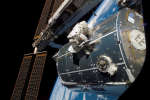 Columbus Laboratory Installed on Space Station
19.02.2008
The International Space Station (ISS) has been equipped with a powerful new scientific laboratory. The Space Shuttle Atlantis delivered the Columbus Laboratory to the ISS and installed the seven meter long module over the past week.
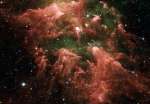 Sculpting the South Pillar
13.03.2008
Eta Carinae, one of the most massive and unstable stars in the Milky Way Galaxy, has a profound effect on its environment. Found in the the South Pillar region of the Carina Nebula, these...
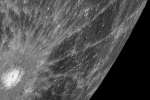 A Spectacular Rayed Crater on Mercury
3.11.2008
Why does Mercury have so many rayed craters? No one is sure. The robotic MESSENGER spacecraft that is taking unprecedented images as it swoops past the innermost planet has provided dramatic confirmation that Mercury has more rayed craters than Earth's Moon.
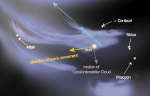 The Local Fluff
29.08.2010
The stars are not alone. In the disk of our Milky Way Galaxy about 10 percent of visible matter is in the form of gas, called the interstellar medium (ISM). The ISM is not uniform, and shows patchiness even near our Sun.
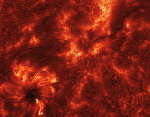 Spicules: Jets on the Sun
2.11.2010
Imagine a pipe as wide as a state and as long as the Earth. Now imagine that this pipe is filled with hot gas moving 50,000 kilometers per hour. Further imagine that this pipe is not made of metal but a transparent magnetic field.
 Mercury Spotting
27.05.2012
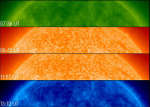
Can you spot the planet? The diminutive disk of Mercury, the solar system's innermost planet, spent about five hours crossing in front of the enormous solar disk in 2003, as viewed from the general vicinity of planet Earth.
 Cape York Annular Eclipse
11.05.2013
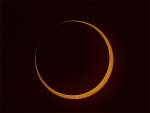
This week the shadow of the New Moon fell on planet Earth, crossing Queensland's Cape York in northern Australia ... for the second time in six months. On the morning...
|
January February March April May June July August September October |
|||||||||||||||||||||||||||||||||||||||||||||||||