
|
You entered: Earth
 The Map Of Eros
26.10.2000
This map of Eros was constructed from a mosaic of images recorded by the NEAR Shoemaker spacecraft, currently orbiting the 40 x 14 x 14 kilometer asteroid. A simple cylindrical projection of an irregularly shaped world, the map's individual images don't always match up at the edges.
 A Sonic Boom
20.02.2001
Many people have heard a sonic boom, but few have seen one. When an airplane travels at a speed faster than sound, density waves of sound emitted by the plane cannot precede the plane, and so accumulate in a cone behind the plane.
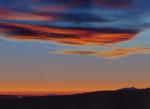 Mercury on the Horizon
12.04.2003
Have you ever seen the planet Mercury? Because Mercury orbits so close to the Sun, it never wanders far from the Sun in Earth's sky. If trailing the Sun, Mercury will be visible low on the horizon for only a short while before sunset.
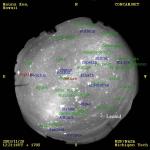 A Late Leonid from a Sparse Shower
24.11.2003
The 2003 Leonids Meteor Shower contained relatively few meteors. As expected and unlike the last few years, the Earth just did not pass through any dense particle streams left over by the Sun-orbiting Comet Tempel-Tuttle.
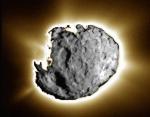 Going Wild
18.03.2004
Dynamic jets of gas and dust surround one of the most active planetary surfaces in the solar system in this wild-looking picture of a comet nucleus. The comet's designation is 81P/Wild...
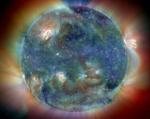 Solstice Celebration
20.06.2004
Season's greetings! Today or tomorrow, depending on your time zone, the Sun reaches its northernmost point in planet Earth's sky marking a season change and the first solstice of the year 2004. In celebration, consider this delightfully detailed, brightly colored image of the active Sun.
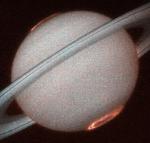 Saturnian Aurora
22.01.1999
Girdling the second largest planet in the Solar System, Saturn's Rings are one of the most spectacular sights for earthbound telescopes. This image from the orbiting Hubble Space Telescope's STIS instrument, offers a striking view of another kind of ring around Saturn - pole encircling rings of ultraviolet aurora.
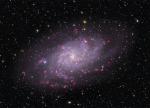 M33: Spiral Galaxy in Triangulum
14.09.2006
The small, northern constellation Triangulum harbors this magnificent face-on spiral galaxy, M33. Its popular names include the Pinwheel Galaxy or just the Triangulum Galaxy. M33 is over 50,000 light-years in diameter, third largest in the Local Group of galaxies after the Andromeda Galaxy (M31), and our own Milky Way.
 Jagged Shadows May Indicate Saturn Ring Particles
15.04.2009
What's causing unusual jagged shadows on Saturn's rings? No one is yet sure. As Saturn nears equinox, its rings increasingly show only their thin edge to the Earth and Sun. As a result, Saturn's moons now commonly cast long shadows onto the rings.
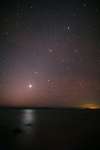 Ecliptic New Zealand
10.07.2010
Four bright celestial beacons and a faint triangle of light follow the plane of the ecliptic as it arcs high through this southern hemisphere night skyscape. Seen on a July winter night from Lake...
|
January February March April May June July August September October |
|||||||||||||||||||||||||||||||||||||||||||||||||