
|
You entered: Earth
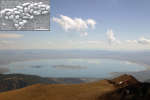 Mono Lake: Home to the Strange Microbe GFAJ 1
6.12.2010
How strange could alien life be? An indication that the fundamental elements that compose most terrestrial life forms might differ out in the universe was found in unusual Mono Lake in California, USA. Bacteria...
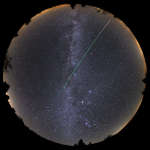 Night of the Long Leonid
22.11.2012
A cosmic grain of sand left the long and colorful trail across this all-sky view. Its grazing impact with planet Earth's atmosphere began at 71 kilometers per second. With the Milky Way stretching...
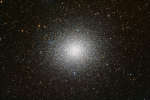 Omega Centauri: The Brightest Globular Cluster
1.05.2013
This huge ball of stars predates our Sun. Long before humankind evolved, before dinosaurs roamed, and even before our Earth existed, ancient globs of stars condensed and orbited a young Milky Way Galaxy. Of the 200 or so globular clusters that survive today, Omega Centauri is the largest, containing over ten million stars.
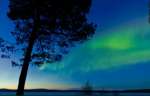 Time Lapse Auroras Over Norway
29.12.2013
Sometimes, after your eyes adapt to the dark, a spectacular sky appears. Such was the case in 2011 March when one of the largest auroral displays in recent years appeared over northern locations like the border between Norway and Russia.
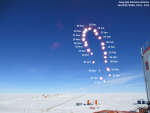 Antarctic Analemma
23.09.2015
Does the Sun return to the same spot on the sky every day? No. A better and more visual answer to that question is an analemma, a composite image taken from the same spot at the same time over the course of a year.
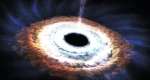 Massive Black Hole Shreds Passing Star
28.10.2015
What happens when a star gets too close to a black hole? Recent observations from Earth-orbiting observatories of an event dubbed ASASSN-14li, in a distant galactic center, appears to be giving one star's harrowing story.
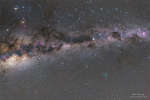 Close Comet and the Milky Way
25.03.2016
Comet 252P/Linear's lovely greenish coma is easy to spot in this expansive southern skyscape. Visible to the naked eye from the dark site near Flinders, Victoria, Australia, the comet appears tailless. Still, its surprisingly bright coma spans about 1 degree, posed here below the nebulae, stars, and dark rifts of the Milky Way.
 50000 Kilometers over the Sun
19.09.2016
What's happening at the edge of the Sun? Although it may look like a monster is rampaging, what is pictured is actually only a monster prominence -- a sheath of thin gas held above the surface by the Sun's magnetic field.
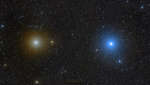 Gemini Stars Pollux and Castor
16.05.2017
Who are the twins of Gemini? It terms of astronomical objects, the famous constellation is dominated by two bright stars: Pollux (left) and Castor (right). Pictured, the two stars stand out because they are so bright, so close together both in angle and brightness, but so different in color.
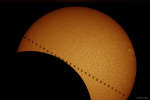 A Fleeting Double Eclipse of the Sun
28.08.2017
Last week, for a fraction of a second, the Sun was eclipsed twice. One week ago today, many people in North America were treated to a standard, single, partial solar eclipse. Fewer people, all congregated along a narrow path, experienced the eerie daytime darkness of a total solar eclipse.
|
January February March April May June July August September October |
|||||||||||||||||||||||||||||||||||||||||||||||||