
|
You entered: Earth
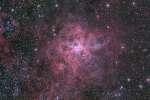 The Cosmic Web of the Tarantula Nebula
17.02.2014
It is the largest and most complex star forming region in the entire galactic neighborhood. Located in the Large Magellanic Cloud, a small satellite galaxy orbiting our Milky Way galaxy, the region's spidery appearance is responsible for its popular name, the Tarantula nebula. This tarantula, however, is about 1,000 light-years across.
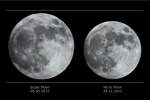 Super Moon vs Micro Moon
8.09.2014
What is so super about tomorrow's supermoon? Tomorrow, a full moon will occur that appears slightly larger and brighter than usual. The reason is that the Moon's fully illuminated phase occurs within a short time from perigee - when the Moon is its closest to the Earth in its elliptical orbit.
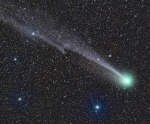 Long Lovejoy and Little Dumbbell
26.02.2015
Buffeted by the solar wind, Comet Lovejoy's crooked ion tail stretches over 3 degrees across this telescopic field of view, recorded on February 20. The starry background includes awesome bluish star Phi Persei below, and pretty planetary nebula M76 just above Lovejoy's long tail.
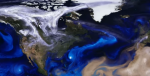 Hurricane Season Animated
27.11.2017
Where do hurricanes go? To better understand dangerous storms, NASA compiled data from several satellites into a supercomputer simulation of this past year's hurricane season. Specifically, the featured video shows how smoke (white), sea salt (blue), and dust (brown) tracked from 2017 August through October across the northern half of Earth's Western Hemisphere.
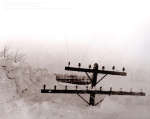 The Upper Michigan Blizzard of 1938
21.01.2018
Yes, but can your blizzard do this? In Upper Michigan's Storm of the Century in 1938, some snow drifts reached the level of utility poles. Nearly a meter of new and unexpected snow fell over two days in a storm that started 80 years ago this week.
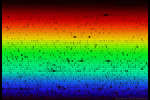 The Suns Spectrum with its Missing Colors
26.09.2018
It is still not known why the Sun's light is missing some colors. Here are all the visible colors of the Sun, produced by passing the Sun's light through a prism-like device.
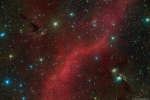 North of Orion s Belt
5.11.2020
Bright stars, interstellar clouds of dust and glowing nebulae fill this cosmic scene, a skyscape just north of Orion's belt. Close to the plane of our Milky Way Galaxy, the wide field view spans just under 5 degrees or about 10 full moons on the sky.
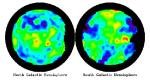 COBE Hotspots: The Oldest Structures Known
6.02.1996
Above are two microwave images of the sky, looking north and south of our galaxy's equator, based on data from NASA's COBE satellite. After computer processing to remove contributions from nearby objects and the effects of the earth's motion, they show "spots".
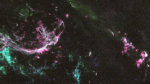 Supernova Remnant: Cooking Elements In The LMC
9.05.1996
Massive stars cook elements in their cores through nuclear fusion. Starting with the light elements of hydrogen and helium, their central temperatures and pressures produce progressively heavier elements, carbon, oxygen, nitrogen, etc. up through iron.
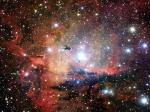 NGC 281: Cluster, Clouds, and Globules
7.04.2003
NGC 281 is a busy workshop of star formation. Prominent features include a small open cluster of stars, a diffuse red-glowing emission nebula, large lanes of obscuring gas and dust, and dense knots of dust and gas in which stars may still be forming.
|
January February March April May June July August September October |
|||||||||||||||||||||||||||||||||||||||||||||||||