
|
You entered: Earth
 A Total Solar Eclipse Over China
5.08.2008
What's that black dot over the Sun? The Moon. This past weekend, the Sun went dark during the day as the Moon completely covered it. The total solar eclipse was visible over a thin swath of Earth extending from northern Canada to China.
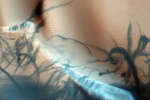 Martian Dust Devil Trails
21.10.2009
Who's been marking up Mars? This portion of a recent high-resolution picture from the HiRISE camera on board the Mars Reconnaissance Orbiter shows twisting dark trails criss-crossing light colored terrain on the martian surface.
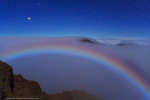 Mars and a Colorful Lunar Fog Bow
1.02.2010
Even from the top of a volcanic crater, this vista was unusual. For one reason, Mars was dazzlingly bright two weeks ago, when this picture was taken, as it was nearing its brightest time of the entire year. Mars, on the far upper left, is the brightest object in the above picture.
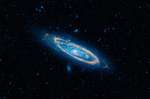 WISE Infrared Andromeda
18.02.2010
This sharp, wide-field view features infrared light from the spiral Andromeda Galaxy (M31). Dust heated by Andromeda's young stars is shown in yellow and red, while its older population of stars appears as a bluish haze. The false-color skyscape is a mosaic of images from NASA's new Wide-field Infrared Survey Explorer (WISE) satellite.
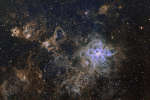 The Cosmic Web of the Tarantula Nebula
10.01.2011
It is the largest and most complex star forming region in the entire galactic neighborhood. Located in the Large Magellanic Cloud, a small satellite galaxy orbiting our Milky Way galaxy, the region's spidery appearance is responsible for its popular name, the Tarantula nebula. This tarantula, however, is about 1,000 light-years across.
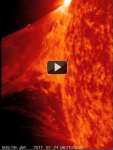 A Solar Prominence Eruption from SDO
6.03.2011
One of the most spectacular solar sights is an erupting prominence. Two weeks ago, NASA's Sun-orbiting Solar Dynamic Observatory spacecraft imaged an impressively large prominence erupting from the surface. The dramatic explosion...
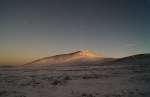 The Snows of Paranal
11.08.2011
Recorded last week, this dawn portrait of snowy mountain and starry sky captures a very rare scenario. The view does feature a pristine sky above the 2,600 meter high mountain Cerro Paranal, but clear skies over Paranal are not at all unusual.
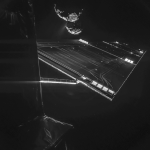 Rosetta s Selfie
16.10.2014
This Rosetta spacecraft selfie was snapped on October 7th. At the time the spacecraft was about 472 million kilometers from planet Earth, but only 16 kilometers from the surface of comet 67P/Churyumov-Gerasimenko. Looming beyond...
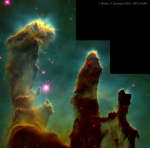 M16: Pillars of Star Creation
23.04.2016
Newborn stars are forming in the Eagle Nebula. This image, taken with the Hubble Space Telescope in 1995, shows evaporating gaseous globules (EGGs) emerging from pillars of molecular hydrogen gas and dust. The giant pillars are light years in length and are so dense that interior gas contracts gravitationally to form stars.
 Sivan 2 to M31
2.03.2017
From within the boundaries of the constellation Cassiopeia (left) to Andromeda (right), this telescopic mosaic spans over 10 degrees in planet Earth's skies. The celestial scene is constructed of panels that are part of a high-resolution astronomical survey of the Milky Way in hydrogen-alpha light.
|
January February March April May June July August September October |
|||||||||||||||||||||||||||||||||||||||||||||||||