
|
You entered: Earth
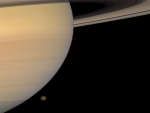 Saturn and Titan from Cassini
24.03.2008
Spectacular vistas of Saturn and its moon continue to be recorded by the Cassini spacecraft. Launched from Earth in 1997, robotic Cassini entered orbit around Saturn in 2004 and has revolutionized much of humanity's knowledge of Saturn, its expansive and complex rings, and it many old and battered moons.
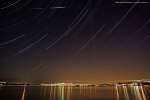 Perseid over Vancouver
16.08.2008
Colorful and bright, the city lights of Vancouver, Canada are reflected in the water in this portrait of the world at night. Recorded on August 12 during the Perseid Meteor Shower, the wide-angle view takes in a large swath along the photographer's eastern horizon.
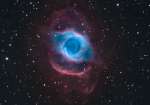 NGC 7293: The Helix Nebula
4.10.2012
A mere seven hundred light years from Earth, in the constellation Aquarius, a sun-like star is dying. Its last few thousand years have produced the Helix Nebula (NGC 7293), a well studied and nearby example of a Planetary Nebula, typical of this final phase of stellar evolution.
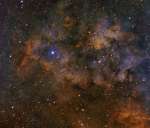 Sharpless 115
14.06.2013
Sharpless 115 stands just north and west of Deneb, the alpha star of Cygnus the Swan in planet Earth's skies. Noted in the 1959 catalog by astronomer Stewart Sharpless (as Sh2-115) the faint...
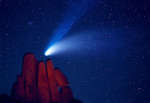 Comet Hale Bopp Over Indian Cove
24.11.2013
Comet Hale-Bopp, the Great Comet of 1997, was quite a sight. In the above photograph taken on 1997 April 6, Comet Hale-Bopp was imaged from the Indian Cove Campground in the Joshua Tree National Park in California, USA. A flashlight was used to momentarily illuminate foreground rocks in this six minute exposure.
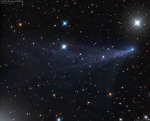 Blue Comet PanSTARRS
12.01.2018
Discovered with the PanSTARRS telescope on September 7, 2016, this Comet PanSTARRS, C/2016 R2, is presently about 24 light minutes (3 AU) from the Sun, sweeping through planet Earth's skies across the background of stars in the constellation Taurus.
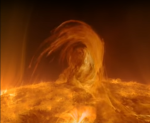 Sun Dance
10.10.2018
Sometimes, the surface of our Sun seems to dance. In the middle of 2012, for example, NASA's Sun-orbiting Solar Dynamic Observatory spacecraft imaged an impressive prominence that seemed to perform a running dive roll like an acrobatic dancer.
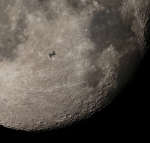 Moon over ISS
6.11.2020
Completing one orbit of our fair planet in 90 minutes the International Space Station can easily be spotted by eye as a very bright star moving through the night sky. Have you seen it? The next time you do, you will have recognized the location of over 20 years of continuous human presence in space.
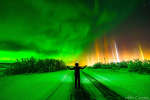 Aurora and Light Pillars over Norway
8.02.2022
Which half of this sky is your favorite? On the left, the night sky is lit up by particles expelled from the Sun that later collided with Earth's upper atmosphere Б creating bright auroras.
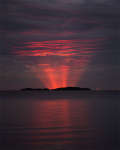 Red Crepuscular Rays from an Eclipse
30.05.2022
What's happening behind that island? Things both expected and unexpected. Expected, perhaps, the pictured rays of light -- called crepuscular rays -- originate from the Sun. Unexpected, though, the Sun was being partially eclipsed by the Moon at the time -- late last month.
|
January February March April May June July August September October |
|||||||||||||||||||||||||||||||||||||||||||||||||