
|
You entered: Earth
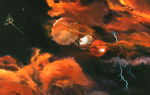 Descent To Jupiter
8.12.1995
Hours ago, at about 5:00 pm EST (2200 GMT) December 7, Galileo's descent probe slammed into Jupiter's atmosphere. Above is an artist's vision of the probe's planned descent from a dramatic perspective.
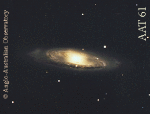 Leo Triplet Spiral Galaxy M65
12.08.1996
Spiral galaxy M65 is a normal spiral galaxy not unlike our own Milky Way. In fact, M65 is a typical spiral galaxy of a type that could be found anywhere in the local universe. Given a morphological type of "Sa", M65 shows tightly wrapped spiral arms and a large nuclear central bulge.
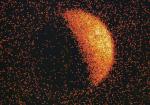 X-Ray Moon
4.10.2003
This x-ray image of the Moon was made by the orbiting ROSAT (Röntgensatellit) Observatory in 1990. In this digital picture, pixel brightness corresponds to x-ray intensity. Consider the image in three parts: the bright hemisphere of the x-ray moon, the darker half of the moon, and the x-ray sky background.
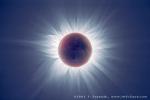 Moon AND Sun
22.11.2003
This composite image was made from 22 separate pictures of the Moon and Sun all taken from Chisamba, Zambia during the total phase of the 2001 June 21 solar eclipse. The multiple exposures were...
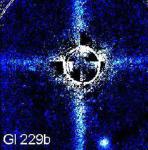 Brown Dwarf Gliese 229B
24.03.1999
The spot near the bottom is an image of an unusual type of object: a brown dwarf. A brown dwarf is sometimes called a "failed star" because it does not have enough mass to shine by nuclear fusion.
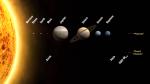 Eight Planets and New Solar System Designations
28.08.2006
How many planets are in the Solar System? This popular question now has a new formal answer according the International Astronomical Union (IAU): eight. Last week, the IAU voted on a new definition for planet and Pluto did not make the cut.
 Jules Verne in Orbit
5.04.2008
The bright edge of planet Earth fades into the darkness of space in the background of this view of Jules Verne on an extraordinary voyage. Snapped last Monday, the picture shows the European Space...
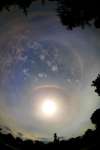 Circles in the Sky
16.05.2008
Gazing skyward on a sunny day in May, photographer Jean-Marc Lecleire captured this engaging display of ice halos forming complete circles in the sky. Recorded with a fish-eye lens from a spot near the grand Château de Chambord in France, the picture looks straight up, spanning almost 180 degrees from horizon to horizon.
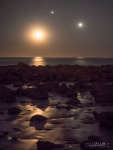 Triple Conjunction Over Galician National Park
24.06.2015
What are those bright objects hovering over the horizon? Planets -- and the Moon. First out, the horizon featured is a shoreline of the Atlantic Ocean that occurs at the Galicia National Park in northern Spain. Next furthest out, on the left, is the Moon.
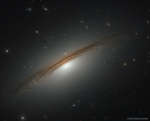 UGC 12591: The Fastest Rotating Galaxy Known
7.03.2017
Why does this galaxy spin so fast? To start, even identifying which type of galaxy UGC 12591 is difficult -- it has dark dust lanes like a spiral galaxy but a large diffuse bulge of stars like a lenticular.
|
January February March April May June July August September October |
|||||||||||||||||||||||||||||||||||||||||||||||||