
|
You entered: Earth
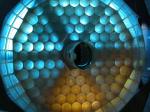 SOFIA s Mirror
22.10.2004
The candy-dish appearance of this high-tech astronomical mirror is striking. Made of a special glass ceramic material called Zerodur, it actually measures 2.7 meters across. The transparent surface has not yet received a reflective...
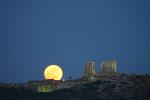 Moonrise, Cape Sounion, Greece
23.06.2005
The Moon was full this month on June 22nd, only a day after the northern hemisphere's summer solstice. Since this solstice marked the northernmost point of the Sun's annual motion through planet...
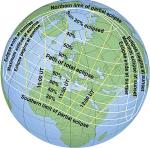 A Total Eclipse for Europe
10.08.1999
The last total solar eclipse of this millennium will be visible for a few minutes tomorrow from a narrow path in Europe and Asia. There, millions of sightseers will witness the Moon move directly between the Earth and Sun, covering up the Sun completely.
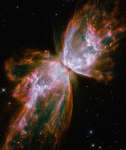 The Butterfly Nebula from Upgraded Hubble
10.09.2009
The bright clusters and nebulae of planet Earth's night sky are often named for flowers or insects, and NGC 6302 is no exception. With an estimated surface temperature of about 250,000 degrees...
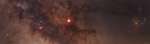 Eclipsed Moon in the Milky Way
17.06.2011
On June 15, the totally eclipsed Moon was very dark, with the Moon itself positioned on the sky toward the center of our Milky Way Galaxy. This simple panorama captures totality from northern Iran in 8 consecutive exposures each 40 seconds long.
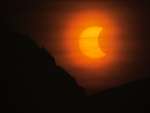 Solar Eclipse over Antarctica
2.12.2011
Last Friday, the fourth and final partial solar eclipse of 2011 was only visible from high latitudes in the southern hemisphere. If you missed it, check out this dramatic picture of the geocentric celestial event from a very high southern latitude on the continent of Antarctica.
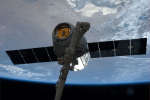 The Space Station Captures a Dragon Capsule
2.06.2014
The space station has caught a dragon. Specifically, in mid-April, the International Space Station captured the unmanned SpaceX Dragon capsule sent to resupply the orbiting outpost. Pictured above, the station's Canadarm2 had just grabbed the commercial spaceship.
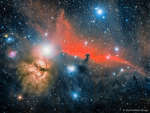 The Horsehead Nebula
16.12.2015
The Horsehead Nebula is one of the most famous nebulae on the sky. It is visible as the dark indentation to the red emission nebula in the center of the above photograph. The horse-head feature is dark because it is really an opaque dust cloud that lies in front of the bright red emission nebula.
 Apollo 15 Panorama
5.08.2016
On July 31, 1971, Apollo 15 astronauts Jim Iwrin and Dave Scott deployed the first Lunar Roving Vehicle on the Moon. Using it to explore their Hadley-Apennine landing site they spent nearly three days on the Moon while Al Worden orbited above.
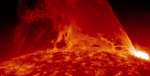 A Solar Prominence Eruption from SDO
26.05.2019
One of the most spectacular solar sights is an erupting prominence. In 2011, NASA's Sun-orbiting Solar Dynamic Observatory spacecraft imaged an impressively large prominence erupting from the surface. The dramatic explosion was captured in ultraviolet light in the featured time lapse video covering 90 minutes, where a new frame was taken every 24 seconds.
|
January February March April May June July August September October |
|||||||||||||||||||||||||||||||||||||||||||||||||