
|
You entered: NASA
 Young Suns
19.02.2000
The star cataloged as NGC2264 IRS is normally hidden from the inquiring gaze of optical telescopes. It resides in the midst of the obscuring gas and dust of a nearby star forming region popularly known as the Cone Nebula.
 High Velocity Clouds and the Milky Way
14.12.1999
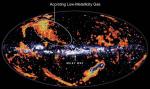
Where are these gas clouds going so quickly? High velocity clouds (HVCs) of gas have been seen for decades but their origins and destinations have remained mysterious. Recent measurements have now placed at least...
 Starburst Cluster in NGC 3603
5.10.2007
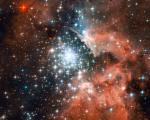
A mere 20,000 light-years from the Sun lies NGC 3603, a resident of the nearby Carina spiral arm of our Milky Way Galaxy. NGC 3603 is well known to astronomers as one of the Milky Way's largest star-forming regions.
 APOD: 2008 April 1- New Space Station Robot Asks to be Called Dextre the Magnificent
1.04.2008
In a surprising and potentially troubling request, the new space station robot known as Dextre demanded that astronauts refer to it in the future at "Dextre the Magnificent." Brandishing power tools that would make...
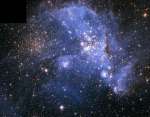 NGC 346 in the Small Magellanic Cloud
17.10.2010
How and why are all these stars forming? Found among the Small Magellanic Cloud's (SMC's) clusters and nebulae NGC 346 is a star forming region about 200 light-years across, pictured above by the Hubble Space Telescope.
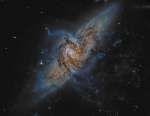 NGC 3314: When Galaxies Overlap
15.07.2011
NGC 3314 is actually two large spiral galaxies which just happen to almost exactly line up. The foreground spiral is viewed nearly face-on, its pinwheel shape defined by young bright star clusters. But against the glow of the background galaxy, dark swirling lanes of interstellar dust appear to dominate the face-on spiral's structure.
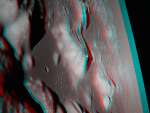 Apollo 17: A Stereo View from Lunar Orbit
13.12.2012
Get out your red/blue glasses and check out this awesome stereo view of another world. The scene was recorded by Apollo 17 mission commander Eugene Cernan on December 11, 1972, one orbit before descending to land on the Moon.
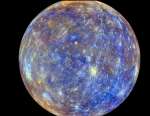 All of Mercury
12.06.2013
For the first time, the entire surface of planet Mercury has been mapped. Detailed observations of the innermost planet's surprising crust have been ongoing since the robotic MESSENGER spacecraft first passed Mercury in 2008 and began orbiting in 2011.
 Flying Past Neptunes Moon Triton
26.08.2014
What would it look like to fly past Triton, the largest moon of planet Neptune? Only one spacecraft has ever done this -- and now, for the first time, images of this dramatic encounter have been gathered into a movie. On 1989 August 25, the Voyager 2 spacecraft shot through the Neptune system with cameras blazing.
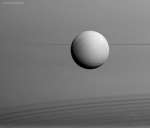 Dione, Rings, Shadows, Saturn
24.08.2015
What's happening in this strange juxtaposition of moon and planet? First and foremost, Saturn's moon Dione was captured here in a dramatic panorama by the robotic Cassini spacecraft currently orbiting the giant planet. The bright and cratered moon itself spans about 1100-km, with the large multi-ringed crater Evander visible on the lower right.
|
January February |
|||||||||||||||||||||||||||||||||||||||||||||||||