
|
You entered: NASA
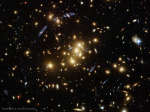 Giant Cluster Bends Breaks Images
23.08.2015
What are those strange blue objects? Many of the brightest blue images are of a single, unusual, beaded, blue, ring-like galaxy which just happens to line-up behind a giant cluster of galaxies. Cluster galaxies here typically appear yellow and -- together with the cluster's dark matter -- act as a gravitational lens.
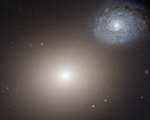 Elliptical M60, Spiral NGC 4647
28.01.2016
Giant elliptical galaxy M60 and spiral galaxy NGC 4647 do look like an odd couple in this sharp cosmic portrait from the Hubble Space Telescope. But they are found in a region of space where galaxies tend to gather, on the eastern side of the nearby Virgo Galaxy Cluster.
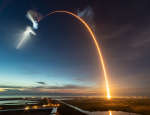 Dawn s Early Light, Rocket s Red Glare
4.07.2018
If you saw the dawn's early light from Cape Canaveral Air Force Station last Friday, June 29, then you could have seen this rocket's red glare. The single 277-second long exposure, made...
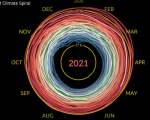 Earths Recent Climate Spiral
22.08.2022
Is our Earth warming? Compared to the past 250 million years, the Earth is currently enduring a relative cold spell, possibly about four degrees Celsius below average. Over the past 120 years, though, data indicate that the average global temperature of the Earth has increased by nearly one degree Celsius.
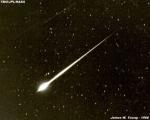 A Leonid Fireball From 1966
13.11.1998
This bright fireball meteor was photographed from Table Mountain Observatory during the peak of the annual Leonid meteor shower on November 17, 1966. That was a good year for Leonid meteor watchers - a meteor "storm" was produced as the Earth swept through a dense swarm of dusty debris from the tail of comet Tempel-Tuttle.
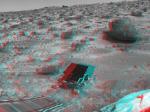 Mars: Yogi And Friends in 3D
16.07.1997
A ramp from the Pathfinder lander, the Sojourner robot rover, airbags, a couch, Barnacle Bill, and Yogi Rock appear together in this 3D stereo view of the surface of Mars. Barnacle Bill is the rock just left of the solar-paneled Sojourner and Yogi is the big friendly-looking boulder at the right.
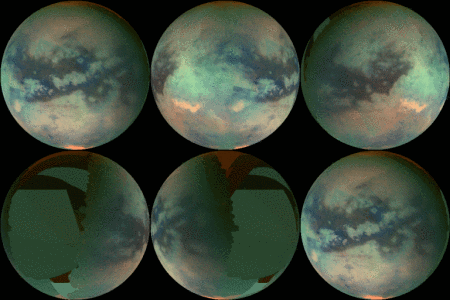 Rotating Titan in Infrared Light
15.02.2006
Titan is one of the strangest places in our Solar System. The only moon known with thick clouds, this unusual satellite of Saturn shows evidence of evaporating lakes created by methane rain. The clouds...
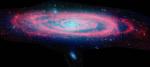 Infrared Andromeda
9.06.2006
This wide, detailed Spitzer Space Telescope view features infrared light from dust (red) and old stars (blue) in Andromeda, a massive spiral galaxy a mere 2.5 million light-years away. In fact, with over twice the diameter of our own Milky Way, Andromeda is the largest nearby galaxy.
 Sandy Gas Jets Hypothesized on Mars
23.08.2006
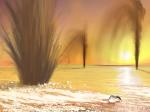
What's causing seasonal dark spots on Mars? Every spring, strange dark spots appear near the Martian poles, and then vanish a few months later. These spots typically span 50 meters across and appear fan shaped. Recent observations made with THEMIS instrument onboard NASA's Mars Odyssey, currently orbiting Marscarbon dioxide (CO2) ice beneath them.
 Abell 2218: A Galaxy Cluster Lens
10.02.2008
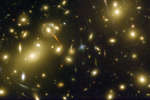
Gravity can bend light, allowing huge clusters of galaxies to act as telescopes. Almost all of the bright objects in this Hubble Space Telescope image are galaxies in the cluster known as Abell 2218.
|
January February |
|||||||||||||||||||||||||||||||||||||||||||||||||