
|
You entered: NASA
 Fermi s Gamma ray Pulsars
9.07.2009
Born in supernovae, pulsars are spinning neutron stars, collapsed stellar cores left from the death explosions of massive stars. Traditionally identified and studied by observing their regular radio pulsations, two dozen pulsars have now been detected at extreme gamma-ray energies by the Fermi Gamma-ray Space Telescope.
 In the Center of the Omega Nebula
6.05.2012
In the depths of the dark clouds of dust and molecular gas known as the Omega Nebula, stars continue to form. The above image from the Hubble Space Telescope's Advanced Camera for Surveys shows exquisite detail in the famous star-forming region.
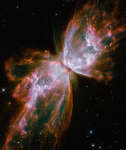 NGC 6903: The Butterfly Nebula
7.06.2013
The bright clusters and nebulae of planet Earth's night sky are often named for flowers or insects. Though its wingspan covers over 3 light-years, NGC 6302 is no exception. With an estimated surface...
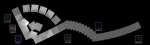 Solar System Portrait
13.02.2015
On another Valentine's Day 25 years ago, cruising four billion miles from the Sun, the Voyager 1 spacecraft looked back one last time to make this first ever Solar System family portrait. The complete portrait is a 60 frame mosaic made from a vantage point 32 degrees above the ecliptic plane.
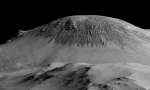 Seasonal Streaks Point to Recent Flowing Water on Mars
30.09.2015
What creates these changing streaks on Mars? Called Recurring Slope Linea (RSL), these dark features start on the slopes of hills and craters but don't usually extend to the bottom. What's even...
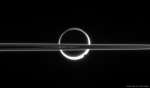 Saturn, Titan, Rings, and Haze
5.05.2019
This is not a solar eclipse. Pictured here is a busy vista of moons and rings taken at Saturn. The large circular object in the center of the image is Titan, the largest moon of Saturn and one of the most intriguing objects in the entire Solar System.
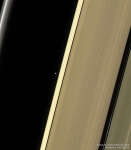 Earth and Moon through Saturns Rings
27.05.2020
What are those dots between Saturn's rings? Our Earth and Moon. Just over three years ago, because the Sun was temporarily blocked by the body of Saturn, the robotic Cassini spacecraft was able to look toward the inner Solar System.
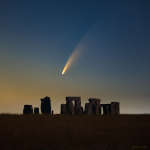 Comet NEOWISE over Stonehenge
14.07.2020
Have you ever seen a comet? Tonight -- and likely the next few nights -- should be a good chance. Go outside just at sunset and look to your northwest. The lower your horizon, the better. Binoculars may help, but if your sky is cloudless and dark, all you should need is your unaided eyes and patience.
 Shadows at the Moons South Pole
10.04.2022
Was this image of the Moon's surface taken with a microscope? No -- it's a multi-temporal illumination map made with a wide-angle camera. To create it, the Lunar Reconnaissance Orbiter spacecraft collected...
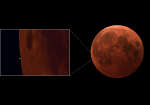 Blood Moon, Ice Giant
11.11.2022
On November 8 the Full Moon turned blood red as it slid through Earth's shadow in a beautiful total lunar eclipse. During totality it also passed in front of, or occulted, outer planet Uranus for eclipse viewers located in parts of northern America and Asia.
|
January February |
|||||||||||||||||||||||||||||||||||||||||||||||||