
|
You entered: NASA
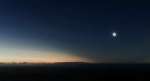 Time Lapse: A Total Solar Eclipse
20.08.2017
Have you ever experienced a total eclipse of the Sun? This time-lapse movie depicts such an eclipse in dramatic detail, seen from Australia in 2012. As the video begins, a slight dimming of the Sun and the surrounding Earth is barely perceptible.
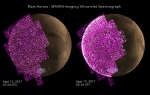 Global Aurora at Mars
6.10.2017
A strong solar event last month triggered intense global aurora at Mars. Before (left) and during (right) the solar storm, these projections show the sudden increase in ultraviolet emission from martian aurora, more than 25 times brighter than auroral emission previously detected by the orbiting MAVEN spacecraft.
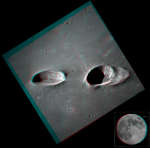 Messier Craters in Stereo
2.12.2017
Many bright nebulae and star clusters in planet Earth's sky are associated with the name of astronomer Charles Messier, from his famous 18th century catalog. His name is also given to these two large and remarkable craters on the Moon.
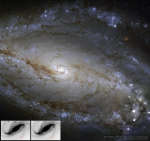 NGC 613 in Dust, Stars, and a Supernova
28.02.2018
Where did that spot come from? Amateur astronomer Victor Buso was testing out a new camera on his telescope in 2016 when he noticed a curious spot of light appear -- and remain. After reporting...
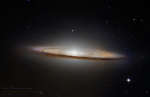 M104: The Sombrero Galaxy
29.03.2019
The striking spiral galaxy M104 is famous for its nearly edge-on profile featuring a broad ring of obscuring dust lanes. Seen in silhouette against an extensive central bulge of stars, the swath of cosmic dust lends a broad brimmed hat-like appearance to the galaxy suggesting a more popular moniker, The Sombrero Galaxy.
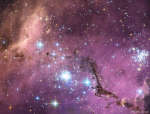 N11: Star Clouds of the LMC
29.04.2019
Massive stars, abrasive winds, mountains of dust, and energetic light sculpt one of the largest and most picturesque regions of star formation in the Local Group of Galaxies. Known as N11, the region...
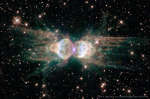 Planetary Nebula Mz3: The Ant Nebula
25.04.2021
Why isn't this ant a big sphere? Planetary nebula Mz3 is being cast off by a star similar to our Sun that is, surely, round. Why then would the gas that is streaming away create an ant-shaped nebula that is distinctly not round?
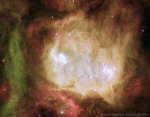 Halloween and the Ghost Head Nebula
24.10.2021
Halloween's origin is ancient and astronomical. Since the fifth century BC, Halloween has been celebrated as a cross-quarter day, a day halfway between an equinox (equal day / equal night) and a solstice (minimum day / maximum night in the northern hemisphere).
 All of These Space Images are Fake Except One
9.11.2021
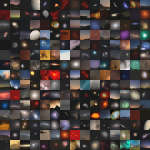
Why would you want to fake a universe? For one reason -- to better understand our real universe. Many astronomical projects seeking to learn properties of our universe now start with a robotic telescope taking sequential images of the night sky.
 Moons Beyond Rings at Saturn
4.01.2022
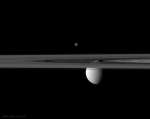
What's happened to that moon of Saturn? Nothing -- Saturn's moon Rhea is just partly hidden behind Saturn's rings. In 2010, the robotic Cassini spacecraft then orbiting Saturn took this narrow-angle view looking across the Solar System's most famous rings.
|
January February |
|||||||||||||||||||||||||||||||||||||||||||||||||