
|
You entered: image
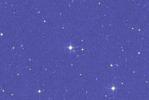 A Planet For Gliese 876
26.06.1998
Centered in this unremarkable, 1/4 degree wide patch of sky in the constellation Aquarius is the star Gliese 876. Gliese 876 is smaller than the Sun, only about 1/3 as massive, and too faint to be seen without a telescope. But it is known to be one of the nearest stars, only 15 light-years distant.
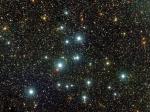 M39: Open Cluster in Cygnus
31.03.2004
Lying just at the limit of human perception is a picturesque starfield containing one of the larger open clusters on the northern sky. Spanning an angle larger than the Moon, M39's relatively few stars lie only about 800 light years distant toward the constellation of Cygnus.
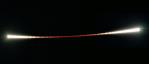 A Time Lapse Lunar Eclipse
3.11.2004
During last week's lunar eclipse, our Moon appeared to disappear. As the Earth moved between the Moon and the Sun, the Earth's shadow fell on the moon, making it quite dark.
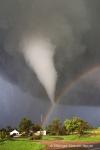 Tornado and Rainbow Over Kansas
2.07.2006
The scene might have been considered serene if it weren't for the tornado. Last June in Kansas, storm chaser Eric Nguyen photographed this budding twister in a different light -- the light of a rainbow. Pictured above, a white tornado cloud descends from a dark storm cloud.
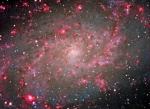 Hydrogen in M33
23.11.2006
Gorgeous spiral galaxy M33 seems to have more than its fair share of hydrogen. Its inner 30,000 light-years are shown here in an image processed to fully reveal the reddish glow of ionized hydrogen regions (HII regions) sprawling along loose spiral arms as they wind toward the galaxy's core.
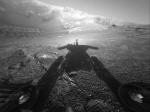 Shadow of a Martian Robot
4.02.2007
What if you saw your shadow on Mars and it wasn't human? Then you might be the Opportunity rover currently exploring Mars. Opportunity and sister robot Spirit have been probing the red planet since early 2004, finding evidence of ancient water, and sending breathtaking images across the inner Solar System.
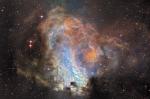 Star Factory Messier 17
10.08.2007
Sculpted by stellar winds and radiation, the star factory known as Messier 17 lies some 5,500 light-years away in the nebula-rich constellation Sagittarius. At that distance, this 30 arcminute field of view spans almost 50 light-years.
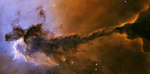 The Fairy of Eagle Nebula
9.12.2007
The dust sculptures of the Eagle Nebula are evaporating. As powerful starlight whittles away these cool cosmic mountains, the statuesque pillars that remain might be imagined as mythical beasts. Pictured above is one of several striking dust pillars of the Eagle Nebula that might be described as a gigantic alien fairy.
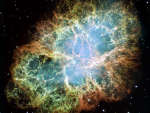 M1: The Crab Nebula from Hubble
17.02.2008
This is the mess that is left when a star explodes. The Crab Nebula, the result of a supernova seen in 1054 AD, is filled with mysterious filaments. The filaments are not only tremendously...
 The Gum Nebula
22.08.2009
Named for Australian astronomer Colin Stanley Gum (1924-1960), The Gum Nebula is so large and close it is actually hard to see. In fact, we are only about 450 light-years from the front edge and 1,500 light-years from the back edge of this cosmic cloud of glowing hydrogen gas.
|
January February March April May June July August September |
|||||||||||||||||||||||||||||||||||||||||||||||||