
|
You entered: image
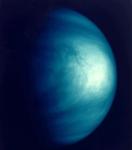 Venus: Just Passing By
1.05.1998
Venus, the second closest planet to the Sun, is a popular way-point for spacecraft headed for the gas giant planets in the outer reaches of the solar system. Why visit Venus first? Using...
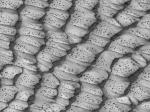 The Dotted Dunes of Mars
31.08.2004
What causes the black dots on dunes on Mars? As spring dawns on the Northern Hemisphere of Mars, dunes of sand near the poles being to defrost. Thinner regions of ice typically thaw first revealing sand whose darkness soaks in sunlight and accelerates the thaw.
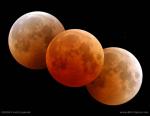 Red Moon Triple
29.10.2004
Some thought of baseball and some thought of Halloween during October 27th's widely viewed total lunar eclipse. Sliding through Earth's shadow, the Moon turned haunting shades of red and orange during the eclipse's total phase.
 Neptune in Infrared
25.10.1999
Neptune has never looked so clear in infrared light. Neptune is the eighth most distant planet from the Sun, thirty times the Earth-Sun distance. Neptune is the fourth largest planet, almost four times Earth's diameter. Surprisingly, Neptune radiates about twice as much energy as it receives from the Sun.
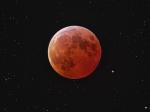 Eclipsed Moon and Stars
8.03.2007
This dramatic image features a dark red Moon during a total lunar eclipse -- celestial shadow play enjoyed by many denizens of planet Earth last Saturday. Recorded near Wildon, Austria, the picture is a composite...
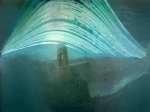 Suspension Bridge Solargraph
15.01.2009
If every picture tells a story, this one might make a novel. The six month long exposure compresses the time from December 17, 2007 to June 21, 2008 into a single point of view.
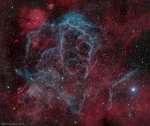 Vela Supernova Remnant
10.09.2010
The plane of our Milky Way Galaxy runs through this complex and beautiful skyscape. At the northwestern edge of the constellation Vela (the Sails) the four frame mosaic is over 10 degrees wide, centered on the glowing filaments of the Vela Supernova Remnant, the expanding debris cloud from the death explosion of a massive star.
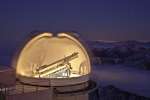 A Glimpse of CLIMSO
25.11.2011
A tantalizing glimpse inside this dome was captured after sunset at the mountain top Pic Du Midi Observatory in the French Pyrenees. But while most are just beginning their work at sunset, this observatory's day was done.
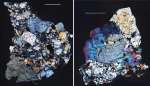 Vesta Rocks
10.12.2011
These colorful images are of thin slices of meteorites viewed through a polarizing microscope. Part of the group classified as HED meteorites for their mineral content (Howardite, Eucrite, Diogenite), they likely fell to Earth from 4 Vesta, the mainbelt asteroid currently being explored by NASA's Dawn spacecraft.
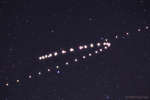 Retrograde Mars
27.10.2014
Why would Mars appear to move backwards? Most of the time, the apparent motion of Mars in Earth's sky is in one direction, slow but steady in front of the far distant stars. About every two years, however, the Earth passes Mars as they orbit around the Sun.
|
January February March April May June July August September |
|||||||||||||||||||||||||||||||||||||||||||||||||