
|
You entered: image
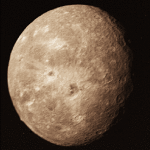 Uranus's Moon Oberon: Impact World
8.04.1996
Oberon is the most distant and second largest moon of Uranus. Discovered by William Herschel in 1787, the properties of the world remained relatively unknown until the robot spacecraft Voyager 2 passed it during its flyby of Uranus in January 1986.
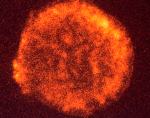 Tycho's Supernova Remnant in X-ray
23.06.1996
How often do stars explode? By looking at external galaxies, astronomers can guess that these events, known as a supernovae, should occur about once every 30 years in a typical spiral galaxy like our MilkyWay.
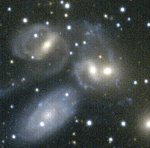 Disorder in Stephan's Quintet
13.12.1996
Five closely grouped galaxies are visible in this image made using the Kitt Peak National Observatory 2.1 meter telescope. The grouping is commonly known as Stephan's Quintet. Four of the galaxies show essentially the same redshift suggesting that they are at the same distance from us.
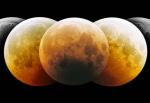 Eclipsed Moon Montage
22.05.2003
After watching this month's lunar eclipse, amateur astronomer Sebastien Gauthier carefully composed this montage of telescopic images of the Moon sliding through planet Earth's shadow. While the deepest part of the total...
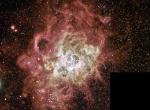 NGC 604: Giant Stellar Nursery
9.12.2003
Stars are sometimes born in the midst of chaos. About 3 million years ago in the nearby galaxy M33, a large cloud of gas spawned dense internal knots which gravitationally collapsed to form stars. NGC 604 was so large, however, it could form enough stars to make a globular cluster.
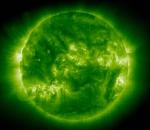 The Iron Sun
25.09.2004
The ultraviolet light emitted by eleven times ionized iron at temperatures over 2 million degrees Farenheit was used to record the above picture of the Sun on September 22, 2001, the date of that year's autumnal equinox.
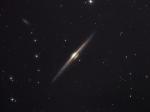 NGC 4565: Galaxy on the Edge
8.07.2005
Magnificent spiral galaxy NGC 4565 is viewed edge-on from planet Earth. Also known as the Needle Galaxy for its narrow profile, bright NGC 4565 is a stop on many telescopic tours of the northern sky as it lies in the faint but well-groomed constellation Coma Berenices.
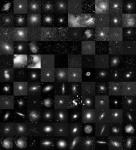 Messier Marathon
18.03.1999
Gripped by an astronomical spring fever, this week many amateur stargazers embark on a Messier Marathon. The Vernal Equinox occurs Saturday, March 20, marking the first day of Spring for the Northern Hemisphere.
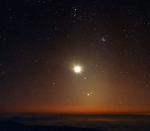 Planets Above The Clouds
4.05.2000
Clouds scatter the faint orange rays of the setting sun in the foreground of this breathtaking photograph from the summit of Mauna Kea, Hawaii. Taken on April 7th, this skyscape features a dramatic lunar and planetary alignment.
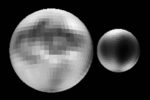 Mysterious Pluto and Charon
9.04.2000
Pluto is the only planet in our Solar System remaining unphotographed by a passing spacecraft. Distant Pluto and its moon Charon therefore remain somewhat mysterious. In addition to direct imaging by the Hubble Space...
|
January February March April May June July August September |
|||||||||||||||||||||||||||||||||||||||||||||||||