
|
You entered: image
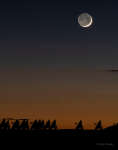 The Old Moon in the Young Moon s Arms
10.11.2018
Tonight the Moon is young again, but this stunning image of a young Moon near the western horizon was taken just after sunset on October 10. On the lunar disk Earthshine, earthlight reflected from the Moon's night side, is embraced by the slim, sunlit crescent just over 2 days old.
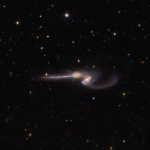 NGC 4676: The Mighty Mice
14.06.2019
These two mighty galaxies are pulling each other apart. Known as The Mice because they have such long tails, each large spiral galaxy has actually passed through the other. Their long tails are drawn out by strong gravitational tides rather than collisions of their individual stars.
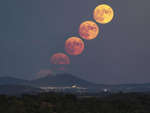 Corn Moon Rising
14.09.2020
A rising moon can be a dramatic sight. A rising Full Corn Moon was captured early this month in time-lapse with a telephoto lens from nearly 30 kilometers away -- making Earth's ascending half-degree companion appear unusually impressive.
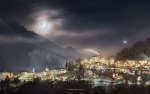 A Lunar Corona with Jupiter and Saturn
19.01.2021
Why does a cloudy moon sometimes appear colorful? The effect, called a lunar corona, is created by the quantum mechanical diffraction of light around individual, similarly-sized water droplets in an intervening but mostly-transparent cloud. Since light of different colors has different wavelengths, each color diffracts differently.
 NGC 6822: Barnard s Galaxy
2.12.2021
Grand spiral galaxies often seem to get all the glory, flaunting their young, bright, blue star clusters in beautiful, symmetric spiral arms. But small galaxies form stars too, like nearby NGC 6822, also known as Barnard's Galaxy.
 APOD: 2024 April 23 Б Contrail Shadow X
23.04.2024
What created this giant X in the clouds? It was the shadow of contrails illuminated from below. When airplanes fly, humid engine exhaust may form water droplets that might freeze in Earth's cold upper atmosphere. These persistent streams of water and ice scatter light from the Sun above and so appear bright from below.
 APOD: 2025 February 17 Б SpaceX Rocket Launch Plume over California
17.02.2025
What's happened to the sky? Last Monday, the photogenic launch plume from a SpaceX rocket launch created quite a spectacle over parts of southern California and Arizona. Looking at times like a giant...
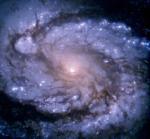 M100: A Grand Design
3.02.2001
Majestic on a truly cosmic scale, M100 is appropriately known as a Grand Design spiral galaxy. A large galaxy of over 100 billion or so stars with well defined spiral arms, it is similar to our own Milky Way.
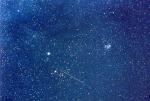 A Leonids Star Field
20.11.2001
As meteor after meteor streaked across a moonless sky, photographers across the world snapped pictures of the 2001 Leonids Meteor Shower. Many recognized this as the best meteor shower they had ever seen. In fact, the 2001 Leonids was the most active meteor shower since the mid-1960s.
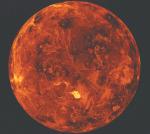 The North Pole of Venus
14.05.2003
If you could look down on the North Pole of Venus what would you see? The Magellan probe that orbited Venus from 1990 to 1994 was able to peer through the thick Venusian clouds and build up the above image by emitting and re-detecting cloud-penetrating radar.
|
January February March April May June July August September |
|||||||||||||||||||||||||||||||||||||||||||||||||