
|
You entered: image
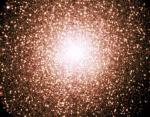 Globular Cluster 47 Tucanae from SALT
5.09.2005
Stars come in bunches. Of the over 200 globular star clusters that orbit the center of our Milky Way Galaxy, 47 Tucanae is the second brightest globular cluster, behind Omega Centauri. Known to some affectionately as 47 Tuc or NGC 104, it is only visible from Earth's Southern Hemisphere.
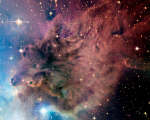 The Fox Fur Nebula from CFHT
22.04.2008
This interstellar beast is formed of cosmic dust and gas interacting with the energetic light and winds from hot young stars. The shape, visual texture, and color, combine to give the region the popular name Fox Fur Nebula.
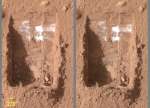 Vanishing Act
21.06.2008
Compare these two close-up pictures taken on sol 20 (left) and sol 24 of a trench dug in the Martian surface by NASA's Phoenix Lander. Those sols of the Phoenix Mission (a sol is a Martian day), correspond to June 15 and 18 on planet Earth.
 From Moonrise to Sunset
21.11.2008
In this panorama of Earth and sky recorded on Thursday, November 13, the Full Moon rises along the eastern horizon at the far left. Of course, the Full Moon rises at sunset and that Thursday's setting Sun was also captured at the far right.
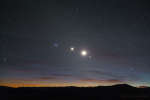 A Morning Line of Stars and Planets
11.07.2012
Early morning dog walkers got a visual treat last week as bright stars and planets appeared to line up. Pictured above, easily visible from left to right, were the Pleiades open star cluster, Jupiter, Venus, and the "Follower" star Aldebaran, all seen before a starry background.
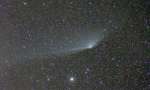 Comet PanSTARRS with Anti Tail
18.05.2013
Once the famous sunset comet, PanSTARRS (C/2011 L4) is now visible all night from much of the northern hemisphere, bound for the outer solar system as it climbs high above the ecliptic plane. Dimmer and fading, the comet's broad dust tail is still growing, though.
 Comet ISON Before and After
29.11.2013
Sungrazing Comet ISON reached perihelion, its closest approach to the Sun, yesterday, November 28, at 18:45 UT. The comet passed just over 1 million kilometers above the solar surface, a distance less than the diameter of the Sun.
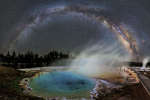 Milky Way over Yellowstone
27.08.2014
The Milky Way was not created by an evaporating lake. The colorful pool of water, about 10 meters across, is known as Silex Spring and is located in Yellowstone National Park in Wyoming, USA. Illuminated artificially, the colors are caused by layers of bacteria that grow in the hot spring.
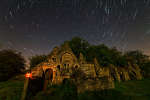 Ghosts and Star Trails
30.10.2015
Don't be scared. Stars won't fall from the sky and ghosts won't really haunt your neighborhood tonight. But it looks like they might be doing just that in this eerie picture of an eccentric old abandoned house in moonlight.
 Stars and Gas of the Running Chicken Nebula
30.05.2016
To some, it looks like a giant chicken running across the sky. To others, it looks like a gaseous nebula where star formation takes place. Cataloged as IC 2944, the Running Chicken Nebula spans about 100 light years and lies about 6,000 light years away toward the constellation of the Centaur (Centaurus).
|
January February March April May June July August September |
|||||||||||||||||||||||||||||||||||||||||||||||||