
|
You entered: sky
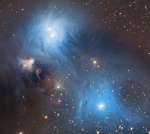 Stars and Dust in Corona Australis
18.10.2017
Blue dust clouds and young, energetic stars inhabit this telescopic vista, less than 500 light-years away toward the northern boundary of Corona Australis, the Southern Crown. The dust clouds effectively block light from more distant background stars in the Milky Way.
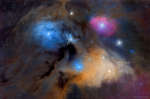 The Colorful Clouds of Rho Ophiuchi
14.10.2020
The many spectacular colors of the Rho Ophiuchi (oh'-fee-yu-kee) clouds highlight the many processes that occur there. The blue regions shine primarily by reflected light. Blue light from the Rho Ophiuchi star system and nearby stars reflects more efficiently off this portion of the nebula than red light.
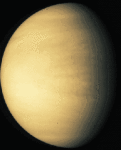 Venus: Earth's Cloudy Twin
23.09.1996
If Venus weren't so cloudy it would be more similar to Earth. This picture by the Galileo spacecraft shows just how cloudy Venus is. Venus is very similar to Earth in size and mass - and so is sometimes referred to as Earth's sister planet - but Venus has a quite different climate.
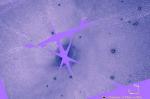 Planet Building in HD 100546
2.05.2001
More than 100 billion boulders may be swarming in the disk around nearby star HD 100546. In a scene thought similar to the early years of our own Solar System, ever larger rocks are growing by colliding and accreting dust as the messy business of planet formation appears to be underway.
 Comet 57P Falls to Pieces
2.08.2002
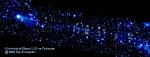
Comet 57P has fallen to pieces, at least 19 of them. Orbiting the Sun every 5.9 years or so this faint comet - also christened Comet 57P/du Toit-Neujmin-Delporte for its three 1941 co-discoverers - is simply...
 A Lucky Lunar Eclipse
3.04.1996
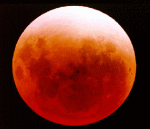
Tonight's full moon would normally washout the spectacle of Comet Hyakutake's lovely tail, even for those far from light polluted skies. Except that tonight comet observers are in luck - the dance of the planets calls for a total lunar eclipse! Lunar eclipses are caused when the Moon passes through the Earth's shadow.
 A Year of Resolving Cosmology
31.12.2003
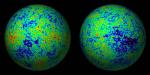
This year, humanity learned that the universe is 13.7 billion years old. Before this year, the universe's age was thought to be about 13 billion years, but really only constrained to be between about 12 billion and 15 billion years old.
 The Cone Nebula Neighborhood
12.04.2007
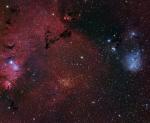
Cosmic clouds of hydrogen gas and dust abound in this gorgeous skyscape, stretching through Monocerous in the neighborhood of The Cone Nebula. A dark, obscuring dust cloud, the simple, sculpted shape of the Cone Nebula is near the lower left edge.
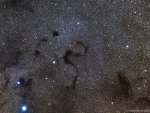 Snake in the Dark
20.02.2009
Dark nebulae snake across a gorgeous expanse of stars in this telescopic view toward the pronounceable constellation Ophiuchus and the center of our Milky Way Galaxy. In fact, the twisting central shape seen here is well known as the Snake Nebula.
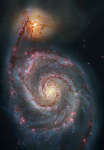 M51 Hubble Remix
26.12.2009
The 51st entry in Charles Messier's famous catalog is perhaps the original spiral nebula - a large galaxy with a well defined spiral structure also cataloged as NGC 5194. Over 60,000 light-years across, M51's spiral arms and dust lanes clearly sweep in front of its companion galaxy (right), NGC 5195.
|
January February March April May June July August September October |
|||||||||||||||||||||||||||||||||||||||||||||||||