
|
You entered: sky
 APOD: 2024 May 1 Б IC 1795: The Fishhead Nebula
1.05.2024
To some, this nebula looks like the head of a fish. However, this colorful cosmic portrait really features glowing gas and obscuring dust clouds in IC 1795, a star forming region in the northern constellation Cassiopeia.
 APOD: 2024 May 11 Б AR 3664: Giant Sunspot Group
11.05.2024
Right now, one of the largest sunspot groups in recent history is crossing the Sun. Active Region 3664 is not only big -- it's violent, throwing off clouds of particles into the Solar System. Some of these CMEs are already impacting the Earth, and others might follow.
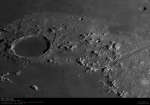 Plato and the Lunar Alps
15.01.2026
The dark-floored, 95 kilometer wide crater Plato and sunlit peaks of the lunar Alps (Montes Alpes) are highlighted in this this sharp telescopic snapshot of the Moon's surface. While the Alps of planet...
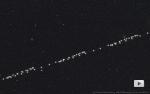 Three Years of Saturn
7.04.2007
Using an image recorded just last month as a base, this composite illustration tracks the motion of bright Saturn as it wanders through planet Earth's night sky. Starting at the upper right, Saturn's position is shown about every two weeks beginning in August 2005 and projected through September 2008.
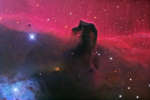 The Horsehead Nebula in Orion
26.11.2008
One of the most identifiable nebulae in the sky, the Horsehead Nebula in Orion, is part of a large, dark, molecular cloud. Also known as Barnard 33, the unusual shape was first discovered on a photographic plate in the late 1800s.
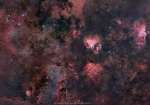 A Sagittarius Starscape
5.09.2014
This rich starscape spans nearly 7 degrees on the sky, toward the Sagittarius spiral arm and the center of our Milky Way galaxy. A telescopic mosaic, it features well-known bright nebulae and star clusters cataloged by 18th century cosmic tourist Charles Messier.
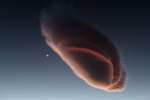 Lenticular Cloud, Moon, Mars, Venus
1.03.2015
It is not every day that such an interesting cloud photobombs your image. The original plan was to photograph a rare angular conjunction of Mars and Venus that occurred a week and a half ago, with the added bonus of a crescent Moon and the International Space Station (ISS) both passing nearby.
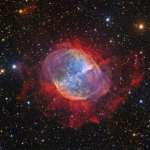 M27 Not a Comet
9.06.2017
While hunting for comets in the skies above 18th century France, astronomer Charles Messier diligently kept a list of the things he encountered that were definitely not comets. This is number 27 on his now famous not-a-comet list.
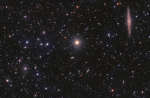 NGC 891 vs Abell 347
2.11.2017
Distant galaxies lie beyond a foreground of spiky Milky Way stars in this telescopic field of view. Centered on yellowish star HD 14771, the scene spans about 1 degree on the sky toward the northern constellation Andromeda. At top right is large spiral galaxy NGC 891, 100 thousand light-years across and seen almost exactly edge-on.
 Trail of the Returner
31.12.2020
Familiar stars of a northern winter's night shine in this night skyview, taken near Zhangye, Gansu, China and the border with Inner Mongolia. During the early hours of December 17 Orion is near...
|
January February March April May June July August September October |
|||||||||||||||||||||||||||||||||||||||||||||||||