
|
You entered: sky
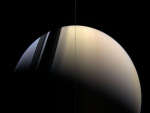 Saturn in Blue and Gold
13.04.2014
Why is Saturn partly blue? The above picture of Saturn approximates what a human would see if hovering close to the giant ringed world. The above picture was taken in 2006 March by the robot Cassini spacecraft now orbiting Saturn. Here Saturn's majestic rings appear directly only as a thin vertical line.
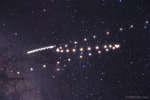 Retrograde Mars and Saturn
15.09.2016
Wandering Mars and Saturn have spent much of this year remarkably close in planet Earth's night sky. In a sequence of exposures spanning mid-December 2015 through the beginning of this week, this composited...
 Big Dipper Above and Below Chilean Volcanoes
9.05.2017
Do you see it? This common question frequently precedes the rediscovery of one of the most commonly recognized configurations of stars on the northern sky: the Big Dipper. This grouping of stars is one of the few things that has likely been seen, and will be seen, by every generation.
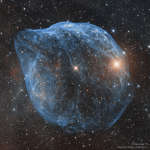 Sharpless 308: The Dolphin Nebula
2.03.2020
Blown by fast winds from a hot, massive star, this cosmic bubble is much larger than the dolphin it appears to be. Cataloged as Sharpless 2-308 it lies some 5,200 light-years away toward the constellation of the Big Dog (Canis Major) and covers slightly more of the sky than a Full Moon.
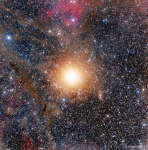 Behind Betelgeuse
11.05.2020
What's behind Betelgeuse? One of the brighter and more unusual stars in the sky, the red supergiant star Betelgeuse can be found in the direction of famous constellation Orion. Betelgeuse, however, is actually...
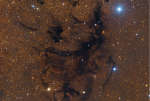 LDN 673: Dark Clouds in Aquila
29.10.2022
Part of a dark expanse that splits the crowded plane of our Milky Way galaxy, the Aquila Rift arcs through planet Earth's skies near bright star Altair. In eerie silhouette against the Milky...
 APOD: 2024 March 3 Б A Total Solar Eclipse Close Up in Real Time
3.03.2024
How would you feel if the Sun disappeared? Many eclipse watchers across the USA surprised themselves in 2017 with the awe that they felt and the exclamations that they made as the Sun momentarily disappeared behind the Moon.
 M27: Not a Comet
5.10.2024
While hunting for comets in the skies above 18th century France, astronomer Charles Messier diligently kept a list of the things encountered during his telescopic expeditions that were definitely not comets. This is number 27 on his now famous not-a-comet list.
 APOD: 2025 July 9 Б A Beautiful Trifid
9.07.2025
The beautiful Trifid Nebula is a cosmic study in contrasts. Also known as M20, it lies about 5,000 light-years away toward the nebula rich constellation Sagittarius. A star forming region in the plane...
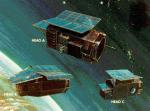 A High Energy Fleet
24.05.1998
Looking like a fleet of futuristic starcruisers, NASA's highly successful series of High Energy Astrophysical Observatory (HEAO) spacecraft appear poised over planet Earth. Labeled A, B, and C in this vintage illustration, the spacebased telescopes were known as HEAO-1, HEAO-2, and HEAO-3 respectively.
|
January February March April May June July August September October |
|||||||||||||||||||||||||||||||||||||||||||||||||