
|
You entered: sky
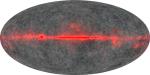 Universe Age from the Microwave Background
17.02.2003
The above sky map tells us the universe is 13.7 billion years old -- but how? At first look, one only sees the microwave glow of gas from our Milky Way Galaxy, coded red, and a spotty pattern of microwaves emitted from the early universe, coded in gray.
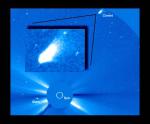 Discovery Image: Comet SOHO (1998 J1)
20.05.1998
Staring at the Sun from a vantage point in space (Kids, don't try this at home!), the Solar and Heliospheric Observatory (SOHO) has enabled the discovery of much about our closest star. It has also been used to discover about 50 comets.
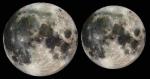 Perigee Moon, Apogee Moon
22.12.1999
Tonight, those blessed with clear skies can enjoy a glorious full moon, the last full moon of the "Y1.9K"s. In fact, tonight's moon will be a full-perigee-solstice moon, reaching its full phase and perigee (the closest point in its orbit) on the solstice, the first day of northern hemisphere winter.
 Unusual Red Glow Over Minnesota
17.02.2009
What in heaven's blazes is that? When landing in Minneapolis, Minnesota, USA in 2002, just after his flight descended below cloud level in the early evening, passenger Tyler Blessing saw and photographed "huge...
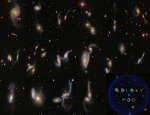 Galaxy Zoo Catalogs the Universe
26.10.2009
You, too, can Zoo. The Galaxy Zoo project has been enabling citizen scientists -- inquisitive people like yourself armed with only a web browser-- to sort through the universe. Specifically, after a brief training session...
 Galaxies, Stars, and Dust
13.10.2012
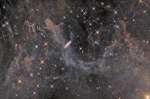
Spiky stars and spooky shapes abound in this deep cosmic skyscape. Its well-composed field of view covers about 2 Full Moons on the sky toward the constellation Pegasus. Of course the brighter stars show diffraction spikes, the commonly seen effect of internal supports in reflecting telescopes, and lie well within our own Milky Way galaxy.
 Orion over El Castillo
21.12.2012
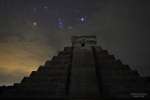
Welcome to the December solstice, a day the world does not end ... even according to the Mayan Calendar. To celebrate, consider this dramatic picture of Orion rising over El Castillo, the central pyramid at Chichén Itzá, one of the great Mayan centers on the Yucatán peninsula.
 A Beautiful Trifid
20.10.2017
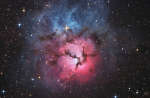
The beautiful Trifid Nebula is a cosmic study in contrasts. Also known as M20, it lies about 5,000 light-years away toward the nebula rich constellation Sagittarius. A star forming region in the plane...
 Clouds in the LMC
19.01.2018
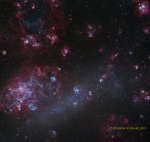
An alluring sight in southern skies, the Large Magellanic Cloud (LMC) is seen in this deep and detailed telescopic mosaic. Recorded with broadband and narrowband filters, the scene spans some 5 degrees or 10 full moons. The narrowband filters are designed to transmit only light emitted by hydrogen, and oxygen atoms.
 APOD: 2023 July 31 Б Phobos over Mars
31.07.2023
Why is Phobos so dark? Phobos, the largest and innermost of the two Martian moons, is the darkest moon in the entire Solar System. Its unusual orbit and color indicate that it may be a captured asteroid composed of a mixture of ice and dark rock.
|
January February March April May June July August September October |
|||||||||||||||||||||||||||||||||||||||||||||||||