
|
You entered: sky
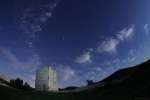 Castle and Meteor by Moonlight
13.08.2011
Each August, as planet Earth swings through dust trailing along the orbit of periodic comet Swift-Tuttle, skygazers enjoy the Perseid Meteor Shower. As Earth moves through the denser part of the comet's wide...
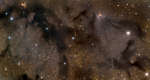 Dark Clouds in Aquila
29.06.2012
Part of a dark expanse that splits the crowded plane of our Milky Way galaxy, the Aquila Rift arcs through the northern hemisphere's summer skies near bright star Altair and the Summer Triangle...
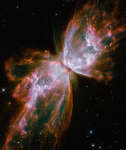 NGC 6903: The Butterfly Nebula
7.06.2013
The bright clusters and nebulae of planet Earth's night sky are often named for flowers or insects. Though its wingspan covers over 3 light-years, NGC 6302 is no exception. With an estimated surface...
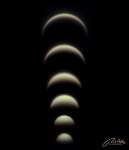 Phases of Venus
20.05.2020
Just as the Moon goes through phases, Venus' visible sunlit hemisphere waxes and wanes. This composite of backyard telescopic images illustrates the steady changes for Venus during its current stint as our evening star, as the inner planet grows larger but narrows to a thin crescent.
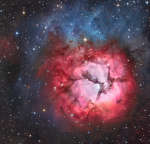 A Beautiful Trifid
11.08.2021
The beautiful Trifid Nebula is a cosmic study in contrasts. Also known as M20, it lies about 5,000 light-years away toward the nebula rich constellation Sagittarius. A star forming region in the plane...
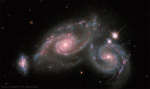 APOD: 2023 January 23 Б The Colliding Spiral Galaxies of Arp 274
22.01.2023
Two galaxies are squaring off in Virgo and here are the latest pictures. When two galaxies collide, the stars that compose them usually do not. This is because galaxies are mostly empty space and, however bright, stars only take up only a small fraction of that space.
 APOD: 2023 December 20 Б Ice Halos over Bavaria
19.12.2023
What's causing those unusual sky arcs? Ice crystals. While crossing a field of fresh snow near Fцssen, Bavaria, Germany, earlier this month, the photographer noticed that he had entered an ice fog.
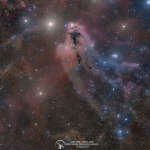 LDN 1622: Dark Nebula in Orion
21.01.2026
The silhouette of an intriguing dark nebula inhabits this cosmic scene. Lynds' Dark Nebula (LDN) 1622 appears against a faint background of glowing hydrogen gas only visible in long telescopic exposures of the region. In contrast, a brighter reflection nebula, vdB 62, is more easily seen just above the dusty dark nebula.
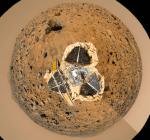 Slightly Above Mars Pathfinder
12.09.2000
If you could have hovered above the Pathfinder mission to Mars in 1997, this is what you might have seen. Directly below you is the control tower of Sagan Memorial Station. Three dark solar...
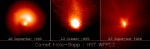 Comet Hale-Bopp Inbound
18.12.1996
Headed toward the inner Solar System, the much anticipated Comet Hale-Bopp has promised to put on a big show next spring. The comet's apparent brightness is currently approaching 4th magnitude and its inbound journey has been closely followed by many observers.
|
January February March April May June July August September October |
|||||||||||||||||||||||||||||||||||||||||||||||||