
|
You entered: sky
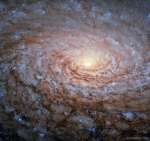 M63: The Sunflower Galaxy from Hubble
9.11.2016
One of the bright spiral galaxies visible in the north sky is M63, the Sunflower Galaxy. M63, also catalogued as NGC 5055, can be found with a small telescope toward the constellation of Hunting Dogs (Canes Venatici).
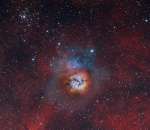 Composite Messier 20 and 21
28.06.2017
The beautiful Trifid Nebula, also known as Messier 20, lies about 5,000 light-years away, a colorful study in cosmic contrasts. It shares this nearly 1 degree wide field with open star cluster Messier 21 (top left).
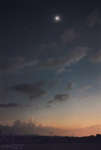 A Total Solar Eclipse of Saros 145
11.08.2017
A darkened sky holds bright planet Venus, the New Moon in silhouette, and the shimmering corona of the Sun in this image of a total solar eclipse. A composite of simultaneous telephoto and wide angle frames it was taken in the path of totality 18 years ago, August 11, 1999, near Kastamonu, Turkey.
 The Horsehead Nebula
27.12.2017
One of the most identifiable nebulae in the sky, the Horsehead Nebula in Orion, is part of a large, dark, molecular cloud. Also known as Barnard 33, the unusual shape was first discovered on a photographic plate in the late 1800s.
 A Phoenix Aurora over Iceland
3.01.2021
All of the other aurora watchers had gone home. By 3:30 am in Iceland, on a quiet September night, much of that night's auroras had died down. Suddenly, unexpectedly, a new burst of particles streamed down from space, lighting up the Earth's atmosphere once again.
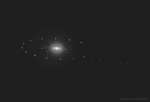 Saturn and Six Moons
6.07.2021
How many moons does Saturn have? So far 82 have been confirmed, the smallest being only a fraction of a kilometer across. Six of its largest satellites can be seen here in a composite...
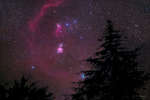 Orion Pines
16.04.2022
Taken with a camera fixed to a tripod, many short exposures were aligned with the stars to unveil this beautiful, dark night sky. Captured near the rural village of Albany`a at the northeastern corner of Spain, the three stars of Orion's belt stretch across top center in the starry frame.
 APOD: 2024 May 26 Б A Solar Filament Erupts
26.05.2024
What's happened to our Sun? Nothing very unusual -- it just threw a filament. Toward the middle of 2012, a long standing solar filament suddenly erupted into space, producing an energetic coronal mass ejection (CME).
 APOD: 2024 October 1 Б Porphyrion: The Longest Known Black Hole Jets
1.10.2024
How far can black hole jets extend? A new record was found just recently with the discovery of a 23-million light-year long jet pair from a black hole active billions of years ago. Dubbed...
 APOD: 2024 October 2 Б The Large Magellanic Cloud Galaxy
2.10.2024
It is the largest satellite galaxy of our home Milky Way Galaxy. If you live in the south, the Large Magellanic Cloud (LMC) is quite noticeable, spanning about 10 degrees across the night sky, which is 20 times larger than the full moon towards the southern constellation of the dolphinfish (Dorado).
|
January February March April May June July August September October |
|||||||||||||||||||||||||||||||||||||||||||||||||