
|
You entered: sky
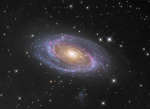 Messier 81
12.03.2021
One of the brightest galaxies in planet Earth's sky is similar in size to our Milky Way Galaxy: big, beautiful Messier 81. Also known as NGC 3031 or Bode's galaxy for its 18th century discoverer, this grand spiral can be found toward the northern constellation of Ursa Major, the Great Bear.
 APOD: 2023 May 30 Б M27: The Dumbbell Nebula
30.05.2023
Is this what will become of our Sun? Quite possibly. The first hint of our Sun's future was discovered inadvertently in 1764. At that time, Charles Messier was compiling a list of diffuse objects not to be confused with comets.
 Aurora Australis and the International Space Station
13.09.2024
This snapshot from the International Space Station was taken on August 11 while orbiting about 430 kilometers above the Indian Ocean, Southern Hemisphere, planet Earth. The spectacular view looks south and east, down toward the planet's horizon and through red and green curtains of aurora australis.
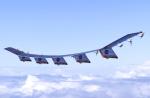 The Flight of Helios
31.08.2001
Solar-powered, remotely piloted, and flying at about 25 miles per hour, NASA's Helios aircraft, is pictured above at 10,000 feet in skies northwest of Kauai, Hawaii on August 13. This ultralight propeller driven aircraft, essentially a flying wing with 14 electric engines, was built by AeroVironment Inc.
 Perseids of Summer
10.08.2001
Like falling stardust, cast off bits of comet Swift-Tuttle hurtle through the upper atmosphere about this time each year as planet Earth passes near the comet's orbital path. For the northern hemisphere, this...
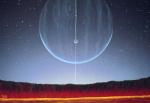 A Year of Assessing Astronomical Hazards
31.12.2002
Could an asteroid destroy civilization on Earth? Mountain-sized space rocks could potentially impact the Earth causing global effects, and perhaps even be mistaken for a nuclear blast of terrestrial origin. Such large impacts are rare but have happened before. Modern telescopes have therefore begun to scan the skies for signs of approaching celestial hazards.
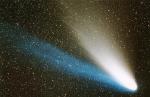 Springtime Comet Fever
20.03.1997
Today marks the Vernal Equinox, the first day of Spring for planet Earth's northern hemisphere. Despite recent attempts by other spectacular and dramatic celestial events to take center stage, Comet Hale-Bopp remains the most popular object in the sky (according to APOD access logs!) and is likely to make this spring memorable for many.
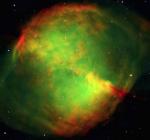 M27: Not A Comet
9.10.1998
While searching the skies above 18th century France for comets, astronomer Charles Messier diligently recorded this object as number 27 on his list of things which are definitely not comets. So what is it?
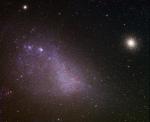 The Small Cloud of Magellan
17.06.2005
Portuguese navigator Ferdinand Magellan and his crew had plenty of time to study the southern sky during the first circumnavigation of planet Earth. As a result, two celestial wonders easily visible for southern hemisphere skygazers are known as the Clouds of Magellan.
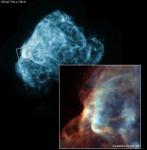 Supernova Remnant and Shock Wave
17.02.2006
A massive star ends life as a supernova, blasting its outer layers back to interstellar space. The spectacular death explosion is initiated by the collapse of what has become an impossibly dense stellar core. Pictured is the expanding supernova remnant Puppis A - one of the brightest sources in the x-ray sky.
|
January February March April May June July August September October |
|||||||||||||||||||||||||||||||||||||||||||||||||